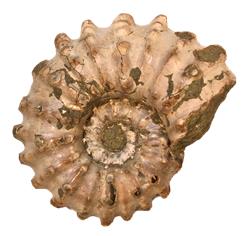
Species. This cosmopolitan genus existed from the early Albian (tardefurcata zone) to the base of the dentatus zone (middle Albian). Kennedy & Klinger (2005) classify most of published species (around forty!) into two long-lived variable forms: D. mammillatum (Schlotheim, 1813), with similar strong ribs (photo on the left), and D. inaequinodum (Quenstedt, 1849), which displays large ventrolateral tubercles and irregular ribs with weaker intermediates. We follow these authors, except for two species that we believe deserve to be retained. D. leightonense Casey, 1962, from the basal Albian, has a broad ventral sulcus and a rapidly diminishing ornamentation. D. clementinum (d'Orbigny, 1841) is a late form from the upper benettianus zone that can reach 80 cm. It is the only Douvilleiceras that survives up to the lower dentatus zone. More recently, Futakami & Haggart (2018) proposed a less drastic revision, which retains seven species.
Remarks. In all Douvilleiceras, the umbilical and lateral tubercles are small and conical on the internal mold, but they are the bases of long, septate spines on the test. These spines are rarely preserved or are lost during preparation, but the best preparators sometimes manage to keep those in the fine specimens from Courcelles (Aube). Some specimens have their venter covered by a shield, a less robust secondary layer that covers the clavi and extends down each flank to the lateral tubercles. This too is rarely preserved or is removed to reveal the clavi.