Created 2025/09/19
Updated 2025/09/25
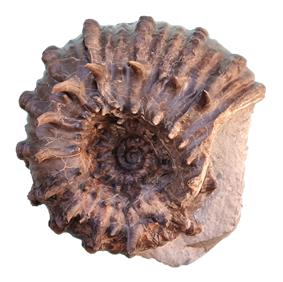
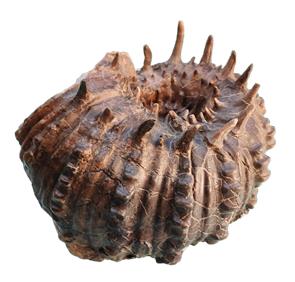
Douvilleiceras inaequinodum (Quenstedt, 1849) with spines
| Measurements |
D mm | H/D | T/D | O/D | H/T |
|---|
| BM 37619 | 49 | 0.42 | 0.56 | 0.32 | 0.75 |
| CP-314 | 75.6 | 0.41 | 0.56 | 0.35 | 0.74 |
| CP-697 | 133 | 0.47 | 0.62 | 0.29 | 0.77 |
| Age |
Origin |
|---|
Bed B of calcareous nodules
Top of benettianus zone
Middle Albian
|
Courcelles quarry
Clérey, Aube
France
|
Description.
A thick, well-preserved ammonite with its brown test, embedded in a gray limestone nodule. One side is not prepared, and sutures are invisible. Whorls depressed, 60% covered, with a broad, inverted U-shaped section. The umbilicus is deep, stepped, with a high, vertical wall curving towards the flank. Fifteen strong ribs, separated by two weak ones.
Each strong rib originates on the umbilicus wall, with a spiny tubercle on its edge. It then bears a higher, spiny lateral tubercle, moving down to the inner third of flank near aperture. Pinched radially, it is pressed against the umbilical wall of next whorl. The rib then becomes progressively stronger, with a flattened crest and three tubercles pinched in the direction of coiling (clavi), increasing to five at the end. It slopes down along the siphonal line, forming a broad groove almost completely filled on the last three ribs.
Between two strong ribs, a weak rib arises indistinctly at the umbilical edge, often with a spiny tubercle, though smaller than that of the strong ribs. Some bear a small lateral tubercle. It bifurcates at this point, or another weak rib detaches from the lateral tubercle of a strong rib. The two resulting weak ribs are then thin, low, and rounded, traversing the venter without collapsing onto the siphon. The last of these bear emerging clavi in the form of subtle undulations.
Remarks.
This specimen is the D. inaequinodum in the Quenstedt sense: like the holotype, it has two weak ribs between two strong ones, a detail highlighted by Guérin-Franiatte in Fischer (2006). Like most of the ammonites from bed B at Courcelles, it is remarkably well preserved, with its test intact. The spiny tubercles were spared thanks to sandblasting. Unlike D. mammillatum or clementinum, which can reach 30 cm and 80 cm respectively, this species appears to be limited to 13 cm, see for example a specimen of the same size on
Ammonites et aliae spirae II.