This page and the menu on the left provide only a basic introduction to a complex subject. Their goal is to explain the vocabulary that must be understood to benefit from ammonite descriptions.
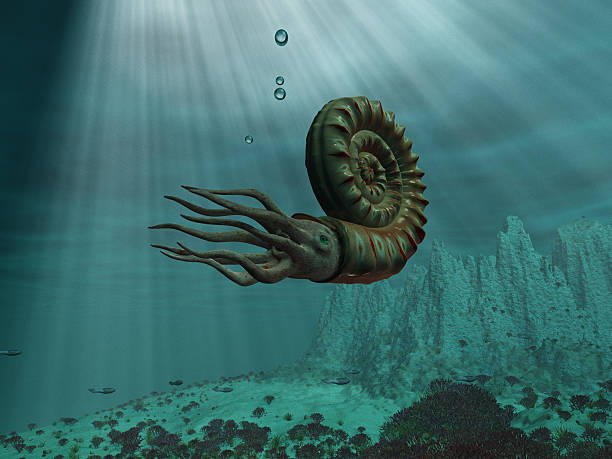
Ammonites are cephalopod molluscs belonging to the extinct order Ammonoidea. They are good stratigraphic markers. Like the order Nautilus, which still exists, their shell is coiled in a spiral (there are also uncoiled forms). The animal swam with the aperture of the shell facing downwards (see figure, taken from iStock) but, traditionally, specimens are depicted upside down in the photographic plates of publications.
The fossil shell or test is made of aragonite, a form of calcium carbonate. The shell conceals successive chambers (camerae) separated by thin walls called septa and filled with air or sea water. The set of empty chambers ended by a septum is called the phragmocone. It is followed by the living chamber (or body chamber), open to the outside, where the animal lives. The septa are crossed by the siphon, a living tube that follows the outer edge of the shell, just below the test. It allows water to be pumped into the empty chambers, like the ballast tanks of submarines. The line of contact between a septum and the test, the suture, has a very sinuous outline that is characteristic of each genus. The simplest criteria for distinguishing between ammonites and nautiluses are that the latter have a siphon running more or less through the centre of the septa and very simple sutures, which are only slightly wavy.
The animal grows by building a new chamber and closing off the old one with a septum. The adult stage is recognised by the final septa being closer together (slower growth), a different aspect of ribs, a change in section shape or an increasingly smaller overlap of the previous whorl (known as scaphoid trend). The living chamber usually occupies half a whorl to one whorl. Its free edge, the peristome, corresponds to the growth zone of the shell. In adults, it is often sinuous, with projections like lateral lappets or a ventral rostrum.
To learn more about ammonites, feel free to explore the menu on the left!