| Measurements | D mm | H/D | T/D | O/D | H/T |
|---|---|---|---|---|---|
| CP-688* | 250 | 0.47 | -- | 0.26 | -- |
| Néotype | 210 | 0.48 | 0.39 | 0.27 | 1.25 |
| Age | Origin |
|---|---|
|
Bed B of nodules lyelli subzone, benettianus zone Base of Middle Albian |
Le Gaty quarry Géraudot, Aube France |
| Measurements | D mm | H/D | T/D | O/D | H/T |
|---|---|---|---|---|---|
| CP-688* | 250 | 0.47 | -- | 0.26 | -- |
| Néotype | 210 | 0.48 | 0.39 | 0.27 | 1.25 |
| Age | Origin |
|---|---|
|
Bed B of nodules lyelli subzone, benettianus zone Base of Middle Albian |
Le Gaty quarry Géraudot, Aube France |
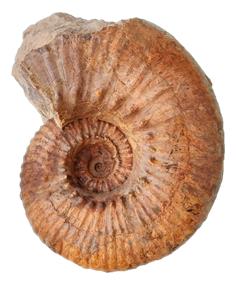
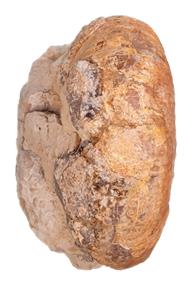
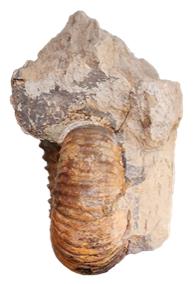
Description. A huge ammonite of 25 cm, weighing 9 kg, with a brown test, found in a nodule of gray limestone. One side is not prepared due to big cracks, preventing measurement of thickness. No septa are visible. The whorls have a semi-circular section and are 50% covered. Deep umbilicus, with a very tall vertical wall connected to the flank via a rounded edge. At the beginning of last whorl, radial, rounded ribs, as wide as interspaces, arise singly or in pairs from umbilical spines. At mid-flank, another spiny tubercle is pressed against the umbilical wall of next whorl, and some ribs branch from it. At the top of the flanks and on venter, the rib crest is undulating (remnants of clavi from the youth), and no ventral sulcus is visible. On the last half-whorl, the umbilical tubercles become blunt, and the lateral ones are reduced to a slight angulation of the ribs. At the same time, the ribs flatten and become smooth, simple, and rursiradiate. The intercalary ribs are shorter and very inconspicuous, giving the impression of more widely spaced ribs. The ribs become even more indistinct on venter. On the last half-whorl, there are 25 umbilical tubercles and 55 ribs.
Remarks. Casey (1962) showed that the beautiful Douvilleiceras with spiny umbilical tubercles from Courcelles (Aube) (see the entry for the specimen at the clavatus stage) are juveniles of Douvilleiceras clementinum. The entries for the 149 mm and 380 mm specimens show two other growth stages. The website ammonites.org features a 25 cm specimen very similar to ours.