| Meansurements | D mm | H/D | T/D | O/D | H/T |
|---|---|---|---|---|---|
| CP-689* | 380 | 0.45 | -- | 0.25 | -- |
| Neotype | 210 | 0.48 | 0.39 | 0.27 | 1.25 |
| Age | Origin |
|---|---|
|
Sandstone in Frécambault Sands lyelli subzone, benettianus zone Middle Albian |
Yonne France |
| Meansurements | D mm | H/D | T/D | O/D | H/T |
|---|---|---|---|---|---|
| CP-689* | 380 | 0.45 | -- | 0.25 | -- |
| Neotype | 210 | 0.48 | 0.39 | 0.27 | 1.25 |
| Age | Origin |
|---|---|
|
Sandstone in Frécambault Sands lyelli subzone, benettianus zone Middle Albian |
Yonne France |
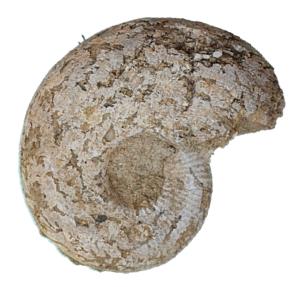
Description. A monstrous and poorly preserved specimen measuring 38 cm and weighing 21.2 kg! Like all fossils from the top of Frécambault Sands, this ammonite has been reworked in a coarse sandstone containing quartz gravels, which has even filled the shell. The unfigured face is abraded, preventing measurement of the exact thickness. Whorls with an inverted U-shaped section, a 50% overlap, parallel lower flanks and a broad, rounded venter without distinct shoulders. Deep umbilicus with a very high vertical wall connected to the flank via a rounded edge. At the beginning of last whorl, simple, rounded radial ribs, as wide as their interspaces, originate at the umbilical margin and cross the venter. The umbilical tubercles are raised bullae at the base of the ribs. The lateral tubercles, the clavi on the ribs, and the ventral sulcus of younger specimens have already disappeared. The ribs become blunt and disappear on the rest of the whorl. The eroded and cracked test shows portions of sutures up to the aperture: hence, even at 38 cm, the body chamber is missing!
Remarks. Personal discovery. This specimen shows that Douvilleiceras clementinum can reach a respectable size, but there are even larger ones. We saw a 70 cm specimen at the same site in the Yonne department, unfortunately very damaged. The Aube Geological Association seems to possess the largest known specimen: a completely smooth monster measuring 80 cm, from Courcelles (Aube department), and even then, most of its body chamber is missing! It is illustrated in Matrion (2010, fig. 129).