Created 2023/05/12
Updated 2026/03/13
Douvilleiceras inaequinodum (Quenstedt, 1849) var. alternans Casey, 1962
| Measurements |
D mm | H/D | T/D | O/D | H/T |
|---|
| CP-110* | 62.5 (55.8) | 0.41 | 0.60 | 0.31 | 0.68 |
| Holotype Casey 1962 | 69 (62) | 0.42 | 0.54 | 0.32 | 0.78 |
| Jaffré 2007 p.61 | 89 | 0.42 | 0.47 | 0.29 | 0.90 |
| BM 37618b Spath 1925 | 92 | 0.45 | 0.52 | 0.30 | 0.87 |
* Measures between two ribs, ignoring ventral tubercles
| Age |
Origin |
|---|
Phosphatic level of Machéroménil
kitchini to puzosianus zones
Lower Albian
|
Ardennes
France
|
Description.
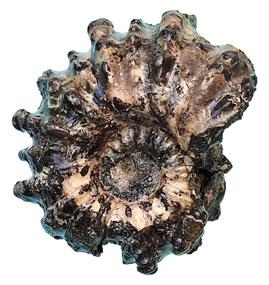
First, read the entry for D. inaequinodum with irregular ribs, which mentions the variants. Ammonite in a reworked nodule of black phosphate, with only one side well preserved, nacreous test remains with a coppery color, and a quarter of body chamber. Depressed, reniform whorls, 40% covered. They widen considerably on the body chamber (deformation?), which exaggerates the T/D ratio. Umbilicus stepped, with a vertical wall and a broadly rounded edge.
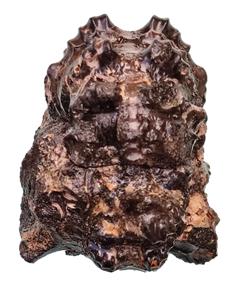
On half of the last whorl, strong ribs are observed with a poorly defined umbilical tubercle (as a sudden onset of the rib), a lateral tubercle as an elongated triangle on the rib, then a ventrolateral one in the form of a rapid elevation near venter, bearing 3 clavi and even 4 at the end of the whorl. The ribs are almost completely effaced along the siphonal line, forming a deep, semicircular groove (right-hand image). On the last half-whorl, a weaker rib is inserted between two successive strong ribs. These ribs have the same tubercles as the strong ones, but proportionally smaller. Some originate slightly higher, without umbilical tubercles. There are 16 ribs in total.
Remarks.
Personal discovery. CP110 matches Douvilleiceras alternans Casey, 1962, defined by an alternation of strong and weak ribs up to 100 mm. A better specimen of 13 cm, from Lower Albian, can be seen on
Ammonites et aliae spirae II. Beyond 100 mm, the number of weak ribs between two strong can reach three. For Kennedy & Klinger (2005), this species is a variant of D. inaequinodum (Quenstedt, 1849). Jaffré (2007) figures a so-called D. mammillatum var. orbignyi Hyatt 1903 with 22 ribs and the same alternation, therefore we put it in the table. In fact, the true D. orbignyi has no weak ribs.