| Measurements | D mm | H/D | T/D | O/D | H/T |
|---|---|---|---|---|---|
| CP-192 | 256 | 0.46 | 0.47 | 0.28 | 0.97 |
| Age | Origin |
|---|---|
|
Aioloceras besairiei Malagasy zone Lower Albian |
Ambatolafia Boeny Region Madagascar |
| Measurements | D mm | H/D | T/D | O/D | H/T |
|---|---|---|---|---|---|
| CP-192 | 256 | 0.46 | 0.47 | 0.28 | 0.97 |
| Age | Origin |
|---|---|
|
Aioloceras besairiei Malagasy zone Lower Albian |
Ambatolafia Boeny Region Madagascar |
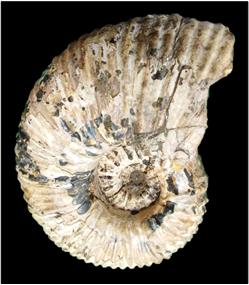
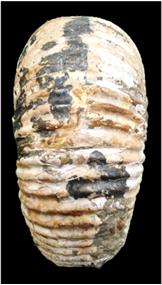
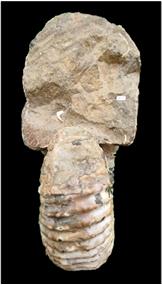
Description. First, read the descriptions of the clavatus and moniliform stages to see the development. Enormous specimen in glauconitic sandstone, complete with its beige test and body chamber. The whorls, as tall as wide, have an inverted U-shaped section and parallel flanks up to two-thirds of their height. They increase rapidly in height and width. The umbilicus has a tall, smooth, vertical wall, connected to the flank by a rounded edge. The radial ribs with a rounded section arise from umbilical tubercles of irregular heights. Numerous bundles of two ribs and shorter intercalary ribs are present. 62 similar ribs cross the venter without forming a siphonal sulcus. At the beginning of last whorl, they are slightly rursiradiate and still in the moniliform stage, with a conical lateral tubercle pressed against the umbilical wall of the following whorl, and five ventrolateral clavi (per flank). The first ribs are covered by a residual shield and cross venter (malformation?). Then, the lateral and ventrolateral tubercles gradually disappear: only smooth ribs remain (apart from their umbilical tubercle), which cross venter perpendicular to the siphonal line.
Remarks. Compared to younger specimens, the siphonal sulcus has disappeared and the whorl section is noticeably higher, though still slightly depressed. Consequently, the height-to-diameter ratio increases while the thickness-to-diameter ratio decreases. Specimens reaching 50–60 cm in diameter are known (Boüault, 1983; Kennedy & Klinger, 2015). Compared to the D. clementinum of the same size, the ornamentation is significantly coarser: compare with the entry for our 380 mm D. clementinum.