Created 2023/05/06
Updated 2025/06/11
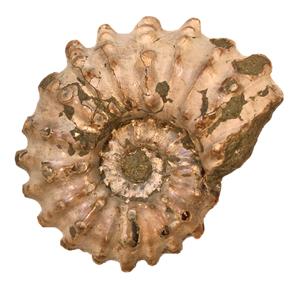
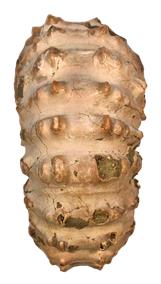
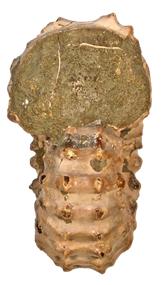
Douvilleiceras mammillatum (von Schlotheim, 1813) – Clavatus stage
| Measurements |
D mm | H/D | T/D | O/D | H/T |
|---|
| CP-46 | 55 | 0.43 | 0.51 | 0.33 | 0.84 |
| Pal.fr. fig. 3.4 | 65 | 0.42 | 0.54 | 0.34 | 0.77 |
| OUM KX9929c* | 73.9 | 0.44 | 0.55 | 0.29 | 0.80 |
| Néotype Casey 1962 | 79 | 0.42 | 0.52 | 0.30 | 0.81 |
* In Kennedy & Klinger (2015)
| Age |
Origin |
|---|
Aioloceras besairiei
Malagasy zone
Lower Albian
|
Ambatolafia
Boeny Region
Madagascar
|
Description.
Evolute ammonite with a pinkish test and one quarter of whorl of body chamber. Depressed reniform whorls with a 40% overlap and a scaphitoid tendency towards the aparture. Wide and deep stepped umbilicus with a vertical wall connected to the flank via a broadly rounded edge. There are 20 strong radial ribs with a rectangular section, narrower than intercostal spaces. Each rib originates on the umbilical margin and bears on each flank one umbilical tubercle and one lateral (both conical), then two clavate ventrolateral tubercles, increasing to three on the last half-whorl.
The lateral tubercle is pressed against the umbilical wall of next whorl. The ribs sag on the siphonal line, giving the impression of an 8 mm wide ventral sulcus, although the venter remains convex between the ribs. An anomaly is noted at 9 o'clock: a bifurcated rib on the lateral tubercle. Such bifurcations are common in the Aptian ancestor Epicheloniceras. Sutures are invisible.
Remarks.
Frequent from the basal Albian to the benettianus zone. Prins (2006) illustrated the progressive appearance of tubercles. The young has three conical tubercles (umbilical, lateral, and ventrolateral). At the clavatus stage, around 3–4 cm, the ventrolateral one divides into 2–3 clavi. At around 6–7 cm, there are around 20 ribs with 4–6 clavi per flank. The umbilical and lateral tubercles remain conical: these are the bases of septate spines, rarely preserved.
At the moniliform stage, around 10–12 cm, the sulcus fills in, and one counts at least 25 ribs, bearing up to 8 former clavi that became pimples. Then the tubercles fade, the umbilical and lateral ones last, and the ribs may even become smooth. These stages are progressive and the diameters indicated are variable. According to Boüault (1983), the adult forms, around 9 cm in diameter, would be microconchs. Compared with D. clementinum, this species has a coarser ornamentation and more spaced ribs.