| Measurements | D mm | H/D | T/D | O/D | H/T |
|---|---|---|---|---|---|
| RJ-1682 | 92 | 0.42 | 0.51 | 0.34 | 0.84 |
| BM C36631 | 93 (88) | 0.43 | 0.51 | -- | 0.84 |
| Holotype | 163 (110) | 0.45 | -- | 0.30 | -- |
| Age | Origin |
|---|---|
|
Aioloceras besairiei Malagasy zone Lower Albian |
Befamonto Boeny Region Madagascar |
| Measurements | D mm | H/D | T/D | O/D | H/T |
|---|---|---|---|---|---|
| RJ-1682 | 92 | 0.42 | 0.51 | 0.34 | 0.84 |
| BM C36631 | 93 (88) | 0.43 | 0.51 | -- | 0.84 |
| Holotype | 163 (110) | 0.45 | -- | 0.30 | -- |
| Age | Origin |
|---|---|
|
Aioloceras besairiei Malagasy zone Lower Albian |
Befamonto Boeny Region Madagascar |
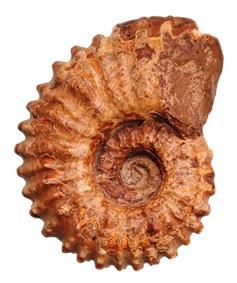
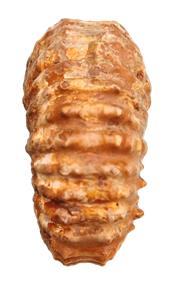
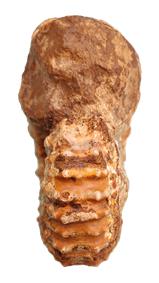
Description. Evolute internal mold in brown sandstone with test remnants, without visible sutures. Whorls slightly depressed, covered by one-third, with a kidney-shaped section. Umbilicus stepped, wide and deep, with a vertical wall that transitions to the flank via a rounded edge. 32 rather low, straight, and radial ribs, with wider intervals, originate from the umbilical edge and bear on each flank a faint periumbilical tubercle (almost a sudden birth of the rib), a pointed lateral tubercle, and four ventrolateral clavi. In order, these latter consist of two low clavi, one stronger, and then a very attenuated one. The ribs cross the venter, sagging between the two strongest clavi, which delineates a wide (22 mm at the aperture) and shallow sulcus. A few ribs originate higher, up to mid-flank, but are as strong as the others on venter. On the last quarter of whorl, the tubercles become blunt, announcing the moniliform stage. A rest of shield covers the last three ribs.
Remarks. One can notice that this specimen has some shorter ribs, but identical to the others on the upper flanks and venter. According to Kennedy & Klinger (2015), D. leightonense is the ancestor of Douvilleiceras mammillatum. It is distinguished from the latter by a wider ventral groove and lower ribs with less steep sides. Moreover, it is the earliest Douvilleiceras, appearing at the top of the tardefurcata zone in England. It was found in the Aube region, at Montreuil-sur-Barse. The tiny clavus between the strongest clavus and the siphonal line seems to be an original characteristic (the last clavus is normally the strongest in D. mammillatum). It is also visible on the holotype, refigured in Kennedy & Klinger (2015, fig. 2).