| Measurements | D mm | H/D | T/D | O/D | H/T |
|---|---|---|---|---|---|
| CP-163 | 134 | 0.43 | 0.54 | 0.31 | 0.80 |
| Collignon 1963 p.116 | 140 | 0.45 | 0.56 | 0.33 | 0.80 |
| Age | Origin |
|---|---|
|
Aioloceras besairiei Malagasy zone Lower Albian |
Ambatolafia Boeny Region Madagascar |
| Measurements | D mm | H/D | T/D | O/D | H/T |
|---|---|---|---|---|---|
| CP-163 | 134 | 0.43 | 0.54 | 0.31 | 0.80 |
| Collignon 1963 p.116 | 140 | 0.45 | 0.56 | 0.33 | 0.80 |
| Age | Origin |
|---|---|
|
Aioloceras besairiei Malagasy zone Lower Albian |
Ambatolafia Boeny Region Madagascar |
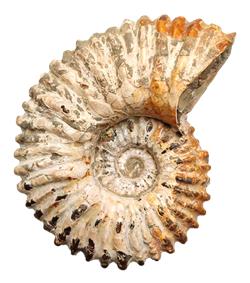
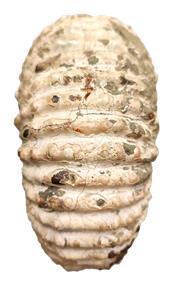
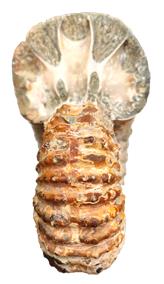
Description. First, read the description of the clavatus stage. A beautiful, thick specimen with a beige test, ending in a white calcite septum. Depressed whorls with a kidney-shaped section, rapidly expanding and overlapping by 40%. Umbilicus broad and deep, with a smooth, vertical wall connected to the flank by a broad, rounded margin. At the beginning of last whorl, the prominent radial ribs, narrower than their interspaces, arise abruptly from a small umbilical tubercle. The conical lateral tubercle, located very low at the inner quarter of the flanks, is followed by six small ventrolateral tubercles of increasing height, still at the claviform stage. The ventral sulcus is shallow but still distinct, 9 mm wide. Next, all tubercles gradually take on the typical pimple-like shape of the moniliform stage. The ribs become less prominent, increasingly close together, and wider than their interspaces. On the last ribs, the tubercles begin to flatten, elongate and merge, while the sulcus becomes indistinct. There are a total of 39 ribs, including 16 shorter intermediate ribs that originate from the lateral tubercles of the other ribs but are quite similar to the main ribs at the top of the flanks.
Remarks. The specimen closely resembles the one illustrated by Collignon in his Atlas des Fossiles Caractéristiques de Madagascar (1963, p. 116), under the name Douvilleiceras solitae (d'Orbigny, 1853): same proportions, same section, same dense ribs with 8 tubercles per flank. However, Collignon's specimen is indeed a D. mammillatum. In fact, Kennedy & Klinger (2015, fig. 19, p. 79) reproduce d'Orbigny's holotype, which is quite different: it has less convex flanks and venter, resulting in a subrectangular cross-section, and it is clearly more evolute (O/D ≈ 0.44).