Created 2023/05/09
Updated 2025/06/22
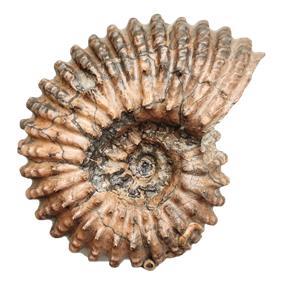
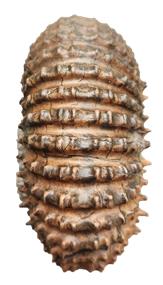
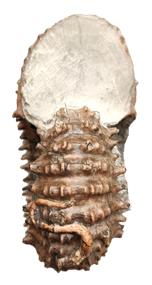
Douvilleiceras clementinum (d'Orbigny, 1841) – clavatus stage
| Measurements |
D mm | H/D | T/D | O/D | H/T |
|---|
| CP-157 | 95 | 0.44 | 0.46 | 0.29 | 0.95 |
| Jaffré 2007 p.59 | 95.2 | 0.43 | 0.49 | 0.29 | 0.87 |
| Age |
Origin |
|---|
Bed B of nodules
lyelli subzone, benettianus zone
Base of Middle Albian
|
Courcelles quarry
Clérey, Aube
France
|
Description.
Ammonite with its test and a serpulid on venter, without visible sutures. The rounded, slightly depressed whorls overlap by 40%. Umbilicus with a high, vertical wall connected to the flank by a broad, rounded margin. 30 low, radial ribs, slightly convex and rursiradiate, with a rectangular section, almost as wide as the intercostal spaces. Each rib bears on each flank a very close and spiny umbilical and lateral tubercles, followed by regularly spaced ventrolateral clavi. These clavi increase from 3 to 6 on the last whorl, resulting in fluted ribs. The lateral tubercle is pressed against the umbilical wall of next whorl and descends progressively lower relative to the height of the flank. On the last half-whorl, a small bulla forms between the umbilical and lateral tubercles. The ribs are shorter on the siphon, which defines a groove 8 mm wide. This groove disappears at the beginning of the last half-whorl, but leaving the two peripheral clavi more spaced than those on the flanks.
Remarks.
Spath (1923, p. 70) created D. albense for Douvilleiceras specimens such as CP-157 and the one illustrated by Bayle (1878, pl. 59), with regular ribs covered by fine clavi, a ventral sulcus that quickly fills in, and sometimes a small siphonal clavus. Casey (1962, pp. 263–264) showed that D. albense is the young D. clementinum, which is the predominant Douvilleiceras in bed B at Courcelles (Aube) and the only one still found at the base of the dentatus zone.
D. mammillatum var. praecox Casey, 1962, is very similar, if not identical. According to Casey, it very quickly reaches the moniliform stage, but the holotype, a quarter of whorl (Casey, 1962, pl. 1, fig. 8a-b, E=34 mm), shows no notable difference with D. clementinum. We added to the table a specimen of this variant, illustrated in Jaffré (2007).