| Measurements | D mm | H/D | T/D | O/D | H/T |
|---|---|---|---|---|---|
| CP-478 | 149 | 0.39 | 0.48 | 0.28 | 0.81 |
| Neotype | 210 | 0.48 | 0.39 | 0.27 | 1.25 |
| Age | Origine |
|---|---|
|
Sandstone in Frécambault Sands lyelli subzone, benettianus zone Middle Albian |
Yonne France |
| Measurements | D mm | H/D | T/D | O/D | H/T |
|---|---|---|---|---|---|
| CP-478 | 149 | 0.39 | 0.48 | 0.28 | 0.81 |
| Neotype | 210 | 0.48 | 0.39 | 0.27 | 1.25 |
| Age | Origine |
|---|---|
|
Sandstone in Frécambault Sands lyelli subzone, benettianus zone Middle Albian |
Yonne France |
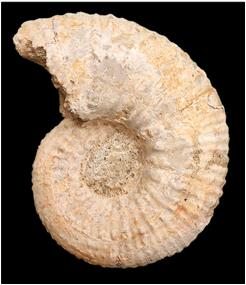
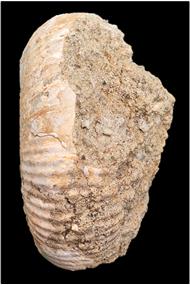
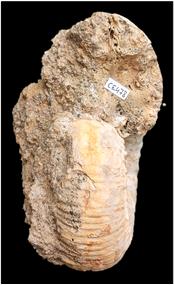
Description. A fully septate ammonite without visible sutures, preserved in a coarse sandstone covered with a fragile beige test, with one side destroyed. The whorls, with a semi-circular section, overlap by 40% and tend to uncoil at the end of the spiral. The umbilicus has a very high, vertical wall and passes to the flank by a broad, rounded margin. The radial ribs are straight, thin, and low, arising from 25 peri-umbilical tubercles, sometimes in pairs or trios, with shorter intercalaries. At mid-flank, a stronger tubercle is pressed against the umbilical wall of next whorl, but it becomes indistinguishable at the end of the spiral. The clavi of the juvenile stage have become simple undulations of the ribs. In total, 65 ribs cross the venter, without ventrolateral sulcus or tubercles. This specimen closely resembles the D. clementinum aubois of 135 mm from plate 3 in Amédro et al. (2014), which however has fewer ribs (45).
Remarks. Personal discovery. The beautiful Douvilleiceras from bed B at Courcelles (Aube) are often called D. mammillatum or its variants aequinodum and praecox, see for example Jaffré (2007, pp. 57-60). It was Casey (1962) who showed that most are in fact juveniles of D. clementinum, see the entry for the juvenile at the clavatus stage. With growth, they lose their ventral sulcus and then their tubercles, except for the umbilical ones. Adults have a slightly compressed section and may lose their umbilical tubercles and even their ribs. The neotype chosen by Guéret-Franiatte in Fischer (2006) has ribs with umbilical bullae only. According to Kennedy & Klinger (2015), D. clementinum is a late variant of D. mammillatum, but in our opinion, it deserves species status given its distinctive features. It is found only in the Paris Basin (Aube, Yonne, Meuse, Pas-de-Calais), in the lyelli subzone of benettianus zone, and, in the Aube department, in the first meter of the dentatus zone.