| Measurements | D mm | H/D | T/D | O/D | H/T |
|---|---|---|---|---|---|
| BM 37619 | 49 | 0.42 | 0.56 | 0.32 | 0.75 |
| CP-314* | 75.6 | 0.41 | 0.56 | 0.35 | 0.74 |
| Age | Origin |
|---|---|
|
D. inaequinodum Malagasy zone Lower Albian |
Malandiandro outlier Boeny Region Madagascar |
| Measurements | D mm | H/D | T/D | O/D | H/T |
|---|---|---|---|---|---|
| BM 37619 | 49 | 0.42 | 0.56 | 0.32 | 0.75 |
| CP-314* | 75.6 | 0.41 | 0.56 | 0.35 | 0.74 |
| Age | Origin |
|---|---|
|
D. inaequinodum Malagasy zone Lower Albian |
Malandiandro outlier Boeny Region Madagascar |
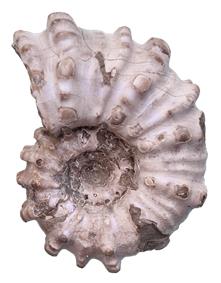
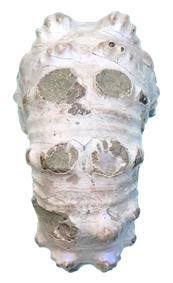
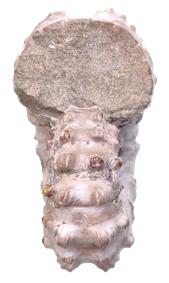
Description. Evolute ammonite with a light gray test, without visible sutures. Depressed reniform whorls overlapping by 1/3 of their height. Umbilicus stepped, wide and deep, with a vertical wall and a broadly rounded edge. 12 strong ribs bear an umbilical tubercle and a larger lateral one, with a bulla between the two at the end of the spiral. They rise near venter to form a big elongate tubercle (some are broken), decorated with two clavi at the beginning of the last whorl and then four near the aperture. They collapse on the siphonal line, giving a deep, semicircular sulcus. There are also 10 weak ribs: four tuberculate like the strong ribs but narrower and lower, and six even thinner and without tubercles. The distribution and spacing of these weak ribs are very irregular. At first there are only strong ribs, then they suddenly space out to make room for two weak, smooth ribs. On the last quarter of whorl, a weak, tuberculate rib and a smooth rib are inserted between two strong ones.
Remarks. Guérin-Franiatte in Fischer (2006) notes that the holotype has two weak ribs between two strong ones. Hyatt (1903) created D. orbignyi for the lost specimen in d'Orbigny pl. 73, which has only strong ribs. Casey (1962) therefore chose as neotype an identical specimen from Bayle (1878, pl. 60, fig. 4) and also defined D. alternans, where strong and weak ribs alternate. In fact, there can be 0 to 3 weak ribs between two strong ones, and they can appear sooner or later (Cooper, 1982). Our specimen is a good example! We therefore follow Kennedy & Klinger (2015), who assign all hypertuberculate Douvilleiceras to D. inaequinodum, which has anteriority. For example, Jaffré (2007) shows a D. orbignyi with alternating ribs, therefore a D. alternans. Matrion (2010) illustrates three others with respectively 0, 1, and 2 weak ribs between two strong ones. Only the one without weak ribs corresponds to Hyatt's ammonite. In any case, they are all D. inaequinodum, by virtue of the anteriority rule.