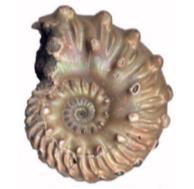
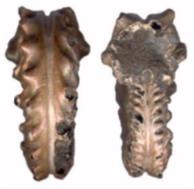
Description. Type species Euhoplites truncatus Spath, 1925. According to Wright (1996), this genus is more or less evolute, with depressed to compressed whorls, a flat or concave venter, and most often a thin, deep canal above the siphon. The ribs are dense, lautiform, and connect umbilical tubercles to prominent ventrolateral clavi that are more or less parallel to the siphonal line. On the less ornamented forms, the ribs, tubercles, or both may be very reduced or absent. This genus occurs from the Middle Albian intermedius zone to the Upper Albian inflatum zone. It is found in Europe, Greenland, and Svalbard.
Species. Spath defined 23 species, some of which are very similar. Amédro (1992) and Amédro et al. (2014) retain five variable species, shown in bold below. The earliest is E. loricatus Spath, 1925, with a concave venter between the clavi but without a thin siphonal canal. The lautiform ribs are strongly projected forward and form spatulae. Covering the Middle Albian intermedius and niobe zones, it includes the following species, from the most compressed, finely ribbed forms to the thickest, with stronger ribs: E. microceras, E. aspasia, E. loricatus, E. pricei et E. subtuberculatus. A variant meandrina with ribs arising by three or four from the umbilical tubercles was elevated to species rank by Owen (1958). The later species that follow, in order of appearance, have a thin siphonal canal.
E. lautus (J. Sowerby, 1821) has lautiform ribs curving forward on the outer third of the flanks and a narrow siphonal canal. It represents the series:E. lautus, E. truncatus, E. opalinus, E. nitidus and E. proboscideus. The photos show a 44 mm E. nitidus from Jim Craig's site. Age: top of niobe zone plus biplicatus zone. E. ochetonotus (Seeley, 1864) also has a thin siphonal canal, but fine and numerous ribs, subradial and moderately flexuous, disappearing with growth. Series by increasing thickness: E. ochetonotus, E. sublautus, E. solenotus, E. serotinus, E. trapezoidalis and E. armatus. Age: in cristatum and pricei zones. E. subcrenatus Spath, 1926, is a microconch form with faint ornamentation from the pricei zone. The rib terminations form a crenulation on both sides of siphonal canal. E. inornatus is an almost smooth variant. According to Amédro (1992), E. subcrenatus is an evolutionary branch of E. ochetonotus, but micromorphic and without descendants. Finally, E. alphalautus Spath, 1925, has sigmoid ribs and a V-shaped venter. The thin siphonal canal is absent or reduced to a flat ribbon. The variants are distinguished by the number of ribs, from highest to lowest: E. alphalautus, E. vulgaris, E. boloniense (see the beautiful V-shaped venter in Spath, 1928, text-fig. 98 p. 296). Group from the pricei and inflatum zones.