| Measurements | D mm | H/D | T/D | O/D | H/T |
|---|---|---|---|---|---|
| Holotype | 38 | 0.47 | 0.42 | 0.21 | 1.12 |
| CP-690* | 41 | 0.50 | 0.47 | 0.21 | 1.06 |
* Measures including tubercles
| Age | Origin |
|---|---|
|
Grey clay, bed II intermedius zone Middle Albian |
Folkestone England |
| Measurements | D mm | H/D | T/D | O/D | H/T |
|---|---|---|---|---|---|
| Holotype | 38 | 0.47 | 0.42 | 0.21 | 1.12 |
| CP-690* | 41 | 0.50 | 0.47 | 0.21 | 1.06 |
* Measures including tubercles
| Age | Origin |
|---|---|
|
Grey clay, bed II intermedius zone Middle Albian |
Folkestone England |
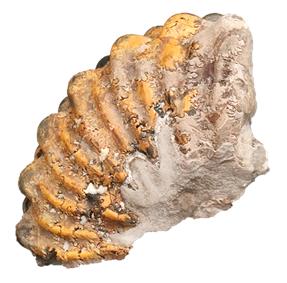
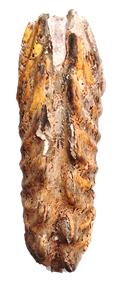
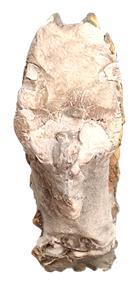
Description. Involute pyritic phragmocone, with whorls covered at 60° and exposed sutures. Trapezoidal whorl section, slightly compressed, with nearly flat flanks converging towards a narrow venter. Abrupt umbilical wall on the inner whorls, with a long 40° slope on the last half-whorl. Fourteen very prominent umbilical tubercles, slightly radially pinched, rising gradually to 40% of the flank height at the end (due to the increasingly less inclined umbilical wall). Fourteen widely spaced ventrolateral clavi, forming subtriangular spatulae parallel to the siphon and alternating on either side of it. Each umbilical bulla gives rise to a bundle of three thin but high ribs, joining a single ventrolateral clavus. The anterior rib of the bundle is straight; the others are folded forward near venter. Sometimes, the front rib joins the next clavus, resulting in a few zigzags. The clavi define a deep, slightly sinuous U-shaped groove. The venter is hollowed out even when traversed between the clavi.
Remarks. CP-690 resembles the ammonites of pl. 29 fig. 3 in Young et al. (2010), of pl. 24 fig. 9-10 in Amédro et al. (2014) and the two specimens of Jim Craig's website. The ventral groove, the projecting lautiform ribs, and the large pinched clavi are typical. Some specimens have bundles of two ribs, with less distinct folds, or a wider groove. In more recent Euhoplites such as E. lautus (see its entry), the concave ventral region has a narrow canal over the siphon. Recall that the following Spath species are considered by Amédro (1992) as variants, from most compressed to thickest: E. microceras, aspasia, loricatus, pricei, and subtuberculatus. The species is found in the intermedius and niobe zones, in beds 2 to 5 at Folkestone, level P4 at Wissant, and bed F at Courcelles.