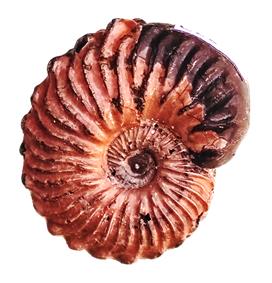
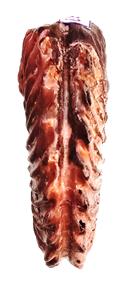
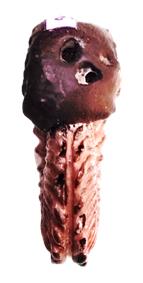
Euhoplites lautus (J. Sowerby, 1821)
| Measurements |
D mm | H/D | T/D | O/D | H/T |
|---|
| Jaffré. 2016 | 29 | 0.48 | 0.38 | 0.24 | 1.27 |
| CP-566 | 34 | 0.40 | 0.36 | 0.26 | 1.20 |
| Pl.25 fig.6 Spath 1928 | 62 | 0.45 | 0.36 | 0.30 | 1.25 |
| Age |
Origin |
|---|
|
Bed VII, Middle Albian
|
Folkestone, England
|
| Var. | lautus | truncatus |
opalinus | nitidus | proboscideus |
|---|
| H/T | 1.16-1.38 | 1.07-1.25 | 0.85-0.88 | 0.66-0.88 | 0.63-0.70 |
| Tub. | 16-18 | 12 | 10-12 | 11 | 10-11 |
| Ribs | 42-48 | 39-43 | 30-40 | 24-36 | 23-24 |
Description.
A chambered, pyritic specimen with a pearly test and whorls 50% covered. The whorl section is slightly compressed, trapezoidal, with flanks converging towards a flat venter, notched by a thin, U-shaped siphonal channel. The umbilicus has a wall sloping at 45°, the edge of which bears 18 small, proverse, projecting, and radially pinched tubercles. Each tubercle gives rise to a pair of lautiform ribs, with a clearly visible bifurcation on the inner whorls. The two ribs of the pair are slightly proverse, initially straight and divergent, then projecting forward at the top of the flank where they meet on a projecting, pinched, clavate tubercle. These clavi, oblique to the siphon, alternate on either side of it. They then tend to become parallel to the siphonal line. Their inner part falls obliquely to the edge of the siphonal canal. Sometimes, the two ribs of a pair terminate on two successive clavi, and some intercalary ribs without an umbilical tubercle are also noted. In total, there are 22 clavi and 41 ribs.
Remarks.
See other specimens in Jaffré (2016), Hadland (2018) and on
Jim Craig's website.
The species resembles in profile its ancestor Euhoplites loricatus (see its entry), which, however, has a wider ventral groove. It is found at Folkestone from bed V to the base of bed IX (biplicatus and cristatum zones), and at Wissant from level P4 to level P5 (Amédro, 2009). Amédro (1992) reclassifies the following species as variants, from most compressed to thickest: Euhoplites lautus (J. Sowerby, 1821); E. truncatus Spath, 1925; E. opalinus Spath, 1930; E. nitidus Spath, 1925; and E. proboscideus (J. Sowerby, 1821). The last table summarizes these variants by compiling the specimens measured by Spath ("Tub." denotes the number of umbilical tubercles). No clear boundary separates them.