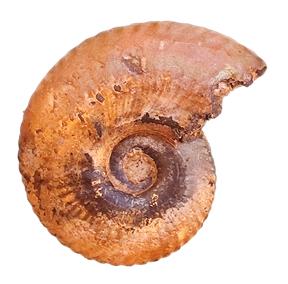
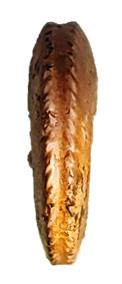
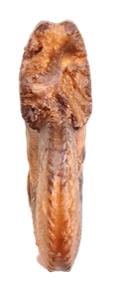
| Measurements | D mm | H/D | T/D | O/D | H/T |
|---|---|---|---|---|---|
| CP-717 | 29.5 | 0.47 | 0.29 | 0.25 | 1.54 |
| Neotype | 44 | 0.40 | 0.26 | 0.30 | 1.54 |
| Age | Origin |
|---|---|
|
Grey clay between P5 and P6 beds, pricei zone, Upper Albian |
Wissant Pas-de-Calais France |
| Measurements | D mm | H/D | T/D | O/D | H/T |
|---|---|---|---|---|---|
| CP-717 | 29.5 | 0.47 | 0.29 | 0.25 | 1.54 |
| Neotype | 44 | 0.40 | 0.26 | 0.30 | 1.54 |
| Age | Origin |
|---|---|
|
Grey clay between P5 and P6 beds, pricei zone, Upper Albian |
Wissant Pas-de-Calais France |
Description. A small, entirely septate, pyritic ammonite covered with a coppery shell. The whorls are 60% covered, with a compressed trapezoidal cross-section, a small umbilicus sloping at 45°, an umbilical wall with a rounded edge, and slightly convex flanks. The venter is hollowed in the shape of an open V. The flanks are nearly smooth, without umbilical bullae. The ribs are reduced to faint striations, visible only under the raking light we applied. In contrast, the ventrolateral shoulders are covered with tiny, closely spaced clavi, oblique to the siphonal line at the beginning of last whorl, then subparallel at the end of coiling. These clavi give the ventrolateral shoulder a finely serrated appearance.
Remarks. According to Amédro (1992), this is an almost smooth form of Euhoplites subcrenatus Spath, 1926 (see its entry). Spath (1930) illustrates two specimens very similar to ours: pl. 28 fig. 5 and pl. 29 fig. 5. The diameter can reach 50 mm and the body chamber can become rounded, lose its ventral channel (pl. 29 fig. 3a-b), and even exhibit constrictions. See also two other specimens on Jim Craig's website. This species is found in bed IX at Folkestone, and between level P5 (not included) and level P6 (inclusive) at Wissant (pricei zone). The proportions, the shape of whorl section with its ventral groove, and the indistinct ribs with small ventrolateral clavi are found in the rare sulcata variety of Anahoplites planus (Spath, 1925, p. 142 and text-fig. 39d). However, like all Anahoplites, this variety has small, distinct, comma-shaped umbilical bullae. Furthermore, according to Spath, it is older: it was collected at Folkestone in bed IV, which corresponds to the niobe zone.