Created 2023/08/07
Updated 2024/10/03
Euhoplites armatus Spath, 1925
| Measurements |
D mm | H/D | T/D | O/D | H/T |
|---|
| CP-109 | 43.9 | 0.47 | 0.62 | 0.32 | 0.75 |
| Holotype Spath | 53 | 0.43 | 0.60 | 0.33 | 0.72 |
| Pl.28 fig.3 Spath | 85 | 0.40 | 0.55 | 0.33 | 0.73 |
| Age |
Origin |
|---|
Phosphatic level P5
cristatum zone
Base of Upper Albian
|
Wissant
Pas-de-Calais
France
|
Description.
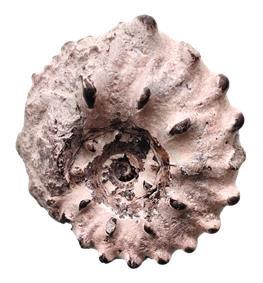
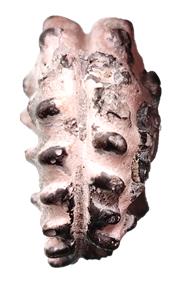
Phragmocone in black phosphate, with test remnants in the form of a pinkish film. Aperture not shown, due to a phosphate plug whose removal is too risky. Shell somewhat involute, with depressed whorls 60% covered. Umbilical wall with a quarter-circle section. On its margin, 10 very tall, radially pinched tubercles. Twice as many protruding, radially pinched ventrolateral tubercles. They are almost perpendicular to the narrow, U-shaped siphonal canal. The flanks are moderately concave between an umbilical and a ventrolateral tubercle. Apart from the siphonal canal, the venter is flat between the two rows of ventrolateral tubercles. Ribs forming loops and zigzags, thin and radial, not projected forward near venter, and becoming indistinct at the end of the spiral.
Remarks.
I got stuck on the identification, because of the external tubercles perpendicular to the siphon, never mentioned for the 23 Euhoplites described by Spath. So I consulted Francis Amédro: it's an Euhoplites armatus, a thick variant of E. ochetonotus (see the genus entry). Spath defines it by a thick form (H/T = 0.72–0.75), 9–11 umbilical pimples, ventrolateral tubercles of the same shape, and radial ribs disappearing around 30 mm in diameter.
The specimens from Hadland (2018, pl. 23) also have these pimple-like tubercles, but the one in pl. 28, fig. 3 from Spath is closer to ours: its tubercles are elongated towards the siphon and have a horizontal ridge line, like the last ones at the top of our ventral view. In fact, according to Francis, my specimen is transitional between E. trapezoidalis Spath, 1930 (less thick and with more persistent ribs) and E. armatus. E. armatus is found in beds VIII and IX of Folkestone and in the phosphatic level P5 of Wissant.