Created 2023/06/13
Updated 2023/07/06
Euhoplites nitidus Spath, 1925
| Measurements |
D mm | H/D | T/D | O/D | H/T |
|---|
| Lectotype Spath | 37 | 0.40 | 0.49 | 0.35 | 0.82 |
| CP-570 | 40.5 | 0.43 | 0.56 | 0.31 | 0.77 |
| BM LFS 8652 | 57 | 0.35 | 0.53 | 0.42 | 0.66 |
| Age |
Origin |
|---|
|
Bed VII, Middle Albian
|
Folkestone, England
|
Description.
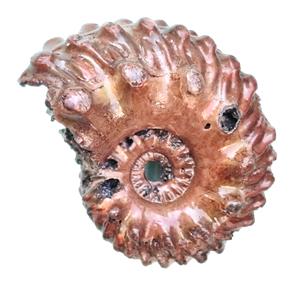
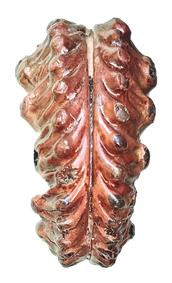
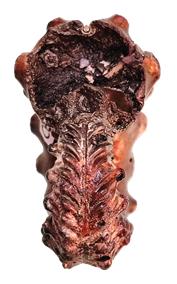
First, read the entry for Euhoplites lautus. This pyritic ammonite is entirely septate, with a pearly test and whorls 40% covered. Its whorl section is distinctly hexagonal, with an umbilical wall occupying 55% of whorl height, followed by flanks converging towards a flat venter, hollowed by a narrow, U-shaped siphonal canal. The umbilical margin bears 12 tubercles, pinched and inclined forward at the beginning of last whorl, then enlarging to form pimples. Each pimple gives rise to three very proverse ribs, connected in an irregular series of loops and zigzags to 28 ventrolateral tubercles with a triangular profile. Behind these tubercles, the ribs continue, sloping down to the edge of the siphonal channel, with which they form a 60° angle. The ventrolateral tubercles quickly also adopt a button-like shape, but smaller than the umbilical tubercles. At the same time, the rib terminations tend to become parallel to the siphonal channel at the end of the spiral.
Remarks.
According to Amédro (1992), this is a thick variant of Euhoplites lautus. The variant table on the latter's entry shows that our H/T ratio of 0.77 corresponds to this variant. However, Spath indicates an O/D ratio of 0.35-0.43 on 4 specimens, and 0.29-0.30 on 3 specimens of E. opalinus: if we use this criterion, our ammonite is then closer to E. opalinus. Such intermediate forms show that we have a spectrum of variation ranging from E. lautus to E. proboscideus, rather than clearly distinct species. Another example of Folkestone can be seen on the website of Jim Craig.