Created 2023/08/09
Updated 2025/10/24
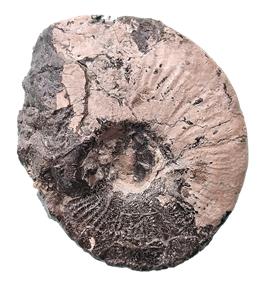
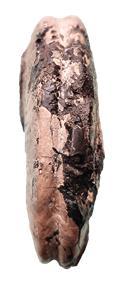
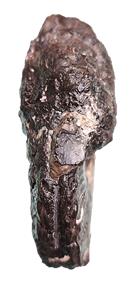
Euhoplites ochetonotus (Seeley, 1864)
| Measurements |
D mm | H/D | T/D | O/D | H/T |
|---|
| LFS 8657 Spath | 85 | 0.48 | 0.29 | 0.24 | 1.65 |
| CP-631 | 85.2 | 0.46 | 0.32 | 0.21 | 1.45 |
| Lectotype Spath | 180 | 0.44 | 0.30 | 0.25 | 1.47 |
| Age |
Origin |
|---|
Phosphatic level P5
Saint-Pô formation (grey clay)
cristatum zone, Upper Albian
|
Wissant
Pas-de-Calais
France
|
Description.
Compressed and involute phragmocone, composed of black phosphate, with remnants of the test in the form of a pinkish film. The whorls, 80% covered, have a high trapezoidal section with slightly convex flanks. At the beginning of last whorl, small, elongated, proverse umbilical tubercles give rise to 3 or 4 very fine, radially oriented, lautiform, and somewhat sigmoid ribs, which terminate in broad, blunt ventrolateral clavi, at first oblique then almost parallel to the narrow siphonal canal. Numerous shorter intercalaries are also present. On the last half-whorl, the umbilical tubercles disappear, the ribs are reduced to faint ridges, and the successive ventrolateral clavi merge to form two broad, smooth half-cylinders, parallel to the siphonal canal. Six ventrolateral tubercles are visible on the penultimate half-whorl (so, 12 per whorl). The ribs are difficult to count, but there are at least 70.
Remarks.
The species occurs in the pricei zone of the Upper Albian of the Anglo-Paris Basin. The site of
Jim Craig shows a 54 mm specimen from bed VIII at Folkestone. At Wissant, it is found in levels P5 and P6. The ventrolateral clavi and then the 10-12 umbilical bullae disappear around 50-75 mm; afterwards, the ribs reduce to fine riblets or even vanish. Euhoplites alphalautus Spath, 1925, which accompanies it, also has numerous fine ribs, giving it a similar profile in juveniles (see its entry). But it has more umbilical bullae (about twenty), the ribs are more sigmoid and more projected forward near venter, the ornamentation persists despite growth and, above all, the venter is hollowed in a V. It is also found in the pricei zone, but it still exists in the inflatum zone.