Created 2025/05/05
Updated 2025/11/07
Euhoplites subcrenatus Spath, 1926
| Measurements |
D mm | H/D | T/D | O/D | H/T |
|---|
| D'Orbigny 5790-2 | 28 | 0.54 | 0.32 | 0.25 | 1.67 |
| CP-680 | 30.4 | 0.47 | 0.33 | 0.26 | 1.42 |
| Holotype | 38 | 0.45 | 0.32 | 0.28 | 1.41 |
| Age |
Origin |
|---|
Grey clay, level P6
pricei and inflatum zones
Upper Albian
|
Wissant
Pas-de-Calais
France
|
Description.
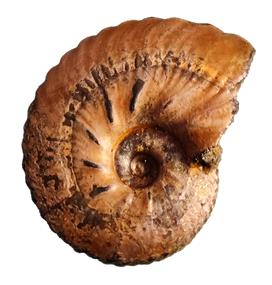
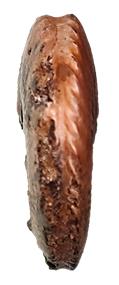
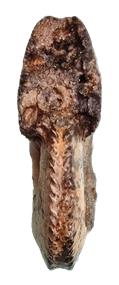
A small, fully septate, involute ammonite made of black phosphate coated with a coppery shell. The whorls are 60% covered, with a compressed trapezoidal section, a small umbilicus with a quarter-circle slope, and slightly convex flanks. The venter, hollowed into an open V shape, has a siphonal canal reduced to a thin, flat band.
The weak ribs were highlighted by raking light on the profile view. Twelve umbilical tubercles, shaped like elongated proverse commas, arise from the umbilical margin and give rise to two or three thin, sigmoid ribs, sometimes falcate at the end of the whorl, projecting forward at the top of the flanks. Two or three intercalary ribs separate two consecutive bundles. The majority of the ribs end in pairs on about forty small, alternating ventrolateral clavi, forming an angle of 40° with the siphonal line at the beginning of the last whorl, reducing to 20° at the end of the spiral. These clavi give a crenellated appearance to the ventrolateral shoulder.
Remarks.
According to Amédro (1992), this is a microconch form with sparse ornamentation, close to E. ochetonotus (Seeley, 1864). Indeed, known specimens are often small (2-3 cm), but Guérin-Franiatte in Fischer (2006, p. 84) mentions a 43 mm specimen from d'Orbigny, and Spath (1930) an English specimen of 50 mm. Guérin-Franiatte emphasizes the V-shaped venter and illustrates a specimen very similar to ours (pl. 45, fig. 7a-b). In our opinion, this V-shaped venter makes E. subcrenatus more closely related to E. alphalautus Spath, 1925. The latter, which can reach a larger size (90 mm), has more umbilical tubercles (around twenty) and stronger, thin ribs that persist as it grows. The two species coexist in level P6 at Wissant and in beds IX and X at Folkestone.