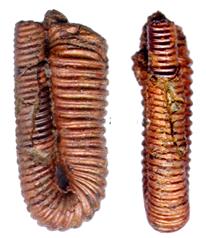
Description. Type species Hamites attenuatus J. Sowerby, 1814. According to Wright (1996), ammonites with irregular coiling, consisting of a small initial spiral, planar or helical, followed by three subparallel shafts. Section circular, depressed or compressed, without tubercles. Ribs simple, annular, radial or oblique, thin and dense to strong and distant, sometimes absent. Sutures with a broad, bifid first lateral lobe (L1) and a smaller, trifid or subbifid dorsal lobe (U). Lower Albian to Upper Cenomanian. Europe, Africa, Madagascar, Australia (Northern Territory), New Zealand, USA, Mexico.
Subgenera. The Hamitidae are a paraphyletic group that includes the ancestors of the Anisoceratidae, Baculitidae, Scaphitidae, and Turrilitidae (Monks, 1999). In particular, the genus Hamites is poorly defined, with heteromorphic ammonites that have not been clearly assigned to other genera (Young et al., 2010). Spath (1941) distinguishes the subgenera Hamites, Psilohamites (Spath, 1941), and Stomohamites (Breistroffer, 1940). The second is smooth and known as shafts, type H. bouchardianus d'Orbigny, 1841. The third is coiled in a very loose spiral, "without exhibiting long, perfectly straight shafts or hooks suddenly curved as a horseshoe" (Breistroffer), type H. virgulatus Brongniart, 1822. Wright (1996) accepts the subgenera Hamites and Psilohamites but not Stomohamites. He adds Lytohamites Casey, 1961, with straight shafts, thin, oblique ribs, and a deeply indented suture, type Lytohamites similis Casey, 1961. We will limit ourselves to the subgenera of Spath and Wright. For the brave, Monks (2002) did a cladistic analysis of the Hamitidae family, which shakes up the classification.
A profusion of species. Since complete specimens are rare, numerous species have been created from shaft fragments, based on cross-section (round, compressed, depressed), rib shape (sharp or blunt, radial or oblique, tapering or not on the back), rib index (number of ribs per length equal to the height of the section), and sutures. Spath (1941) thus describes 23 English species, including 7 new ones! Some are very similar, and Spath acknowledges the existence of numerous transitional forms. A statistical analysis would likely allow to retain only a few species with a wide range of variation.
Remarks. Hamites is uncommon in Aube but abundant in levels P4 and P5 at Wissant (cristatum and pricei zones), as shaft fragments. Amédro (2009) cites Hamites (Psilohamites) bouchardianus, Hamites attenuatus, H. rotundus, and H. gibbosus there. The photograph on the left, from Jim Craig's site, illustrates the latter.