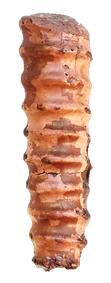
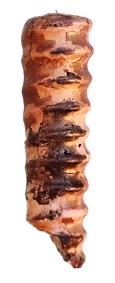
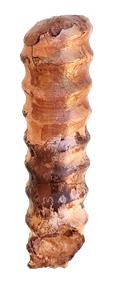
| Measurements | L mm | H mm | T mm | H/T |
|---|---|---|---|---|
| CP-715 | 42.6 | 12.3 | 11.6 | 1.06 |
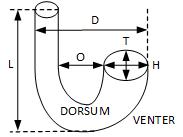
| Age | Origin |
|---|---|
|
Level P5, cristatum zone Base of Upper Albian |
Wissant Pas-de-Calais, France |
| Measurements | L mm | H mm | T mm | H/T |
|---|---|---|---|---|
| CP-715 | 42.6 | 12.3 | 11.6 | 1.06 |
| Age | Origin |
|---|---|
|
Level P5, cristatum zone Base of Upper Albian |
Wissant Pas-de-Calais, France |
Description. Fragment of straight shaft of a heteromorph ammonite, made of black phosphate and covered with a pearly shell with portions of visible sutures. The cross-section appears circular, but calipers show that it is slightly compressed. The ribs are spaced apart, strong but blunt, and proverse on the flanks. They cross the dorsum, tapering and thinning, and form a broad and pronounced backward sinus. No trace of tubercles. The rib index is only 3. Two points of clarification: a) in the photographs, the top gives the direction of aperture, and the dorsum is on the left in the flank view; b) for uncoiled ammonites, a rib is rursiradiate if it inclined backward when it is followed from dorsum to venter.
Remarks. Hamites intermedius J. Sowerby, 1814, has a slightly compressed cross-section, widely spaced, low, and rounded proverse ribs, and a strong backward sinus on dorsum. Typical forms have a rib index of 4. Spath created the variety distincta for forms with a rib index dropping to 3 (1941, text-fig 229, n-p, and pl. 71, fig. 4). According to him, this is the only Hamites in the English Gault with such widely spaced ribs. We have not found any specimens with measurements in the literature. The genus Lechites also includes heteromorph ammonites with widely spaced and proverse ribs, but it has a less incised suture, with a first lateral lobe L1 that is sub-rectangular and a small, triangular dorsal lobe U. Furthermore, it is found higher, in the late Albian.