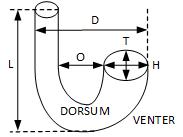
| Measurements | L mm | H mm | T mm | H/T |
|---|---|---|---|---|
| CP-714 | 54 | 11.4 | 12.4 | 0.92 |
| Age | Origin |
|---|---|
|
Phosphatic level P5 cristatum zone Base of Upper Albian |
Wissant Pas-de-Calais, France |
| Measurements | L mm | H mm | T mm | H/T |
|---|---|---|---|---|
| CP-714 | 54 | 11.4 | 12.4 | 0.92 |
| Age | Origin |
|---|---|
|
Phosphatic level P5 cristatum zone Base of Upper Albian |
Wissant Pas-de-Calais, France |
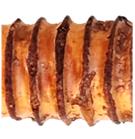
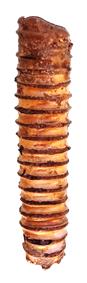
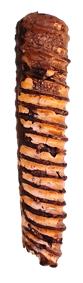
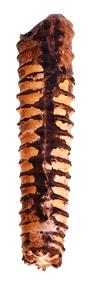
Description. Heteromorph ammonite preserved as a straight section of shaft in black phosphate. It is covered with a coppery shell and begins with a septum, with no other visible sutures. The cross-section appears circular, but calipers reveal it to be a bit depressed, mainly due to a slightly flattened dorsum. The ribs are very prominent on the venter and flanks, with a sharp crest and wider intercostal spaces. They are straight but rursiradiate on the flanks. They cross the dorsum, becoming blunt and forming a broad, shallow proverse sinus. No trace of tubercles. The rib index varies between 4 and 5. Two points of clarification: a) in the photographs, the top gives the direction of aperture, and the dorsum is on the left in the flank view; b) for uncoiled ammonites, a rib is rursiradiate if it inclined backward when it is followed from dorsum to venter.
Remarks. This is the most easily recognizable Hamites from Wissant, thanks to its slightly depressed section and high, sharp and widely spaced ribs (see the enlarged view on the right). This gives it an accordion-like appearance, according to Young et al., who illustrate a very similar specimen (2010, pl. 37, fig. 2). Spath (1941) also illustrates specimens (p. 626, text-fig. 226, and pl. 70, figs. 6-11). None of these authors provides dimensions, which is why there are no other examples in our table of measurements.