| Measurements | L mm | H mm | T mm | H/T |
|---|---|---|---|---|
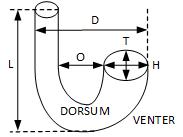
| CP-716 | 50.3 | 9.1 | 8.9 | 1.02 |
| Age | Origin |
|---|---|
|
Grey clay between P5 and P6 levels pricei zone, Upper Albian |
Wissant Pas-de-Calais, France |
| Measurements | L mm | H mm | T mm | H/T |
|---|---|---|---|---|
| CP-716 | 50.3 | 9.1 | 8.9 | 1.02 |
| Age | Origin |
|---|---|
|
Grey clay between P5 and P6 levels pricei zone, Upper Albian |
Wissant Pas-de-Calais, France |
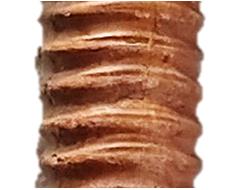
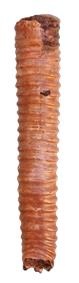
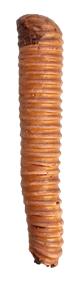
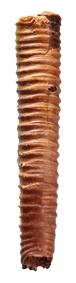
Description. From left to right, the pictures correspond respectively to the venter, flank and dorsum. A slightly wavy shaft segment in black phosphate, covered with a coppery test and beginning with a septum, with no other visible sutures. Quasi-circular cross-section. The ribs are numerous, radial, thin, and close together, but with slightly larger and sometimes irregular interspaces. They are prominent but broadly rounded, with a semicircular section. They cross the dorsum, becoming blunt, with a subtle feature visible under magnification (photo on the right): the ribs separate into two fine striations, forming a loop (fibula). No trace of tubercles. The rib index is 7. In the photographs, the anterior extremity is at the top, and the dorsum is on the left on the flank view.
Remarks. Pictet & Campiche (1847, p. 135, pl. 14, figs. 7-10) assigned this ammonite to Hamites virgulatus Brongniart. They isolated the species in 1861 (p. 98) for the specimens in figures 7-9. Another distinctive feature of the species is an aperture with two annular collars, separated by a deep groove. This rare Hamites is also illustrated by Spath (1941, pp. 640-642) and Gale et al. (2011, figs. 30, A and 36, D, E, G, I). At first, I did not notice the fibulae and identified CP-716 as Hamites (Hamites) rotundus J. Sowerby, 1914, which also has a round section with closely spaced radial ribs. The fibulae should not be confused with those of Anisoceras, where they connect two ventrolateral tubercles on each side of the venter. I have not found any specimens with measurements in the literature.