Description. Type species Ammonites beudanti Brongniart, 1822. According to Wright et al. (1996), this is a compressed genus, moderately to very involute, with flat or convex flanks and a more or less narrowly arched, but not sharp, venter. It may display proverse, sinuous, shallow but distinct, falcate, or biconcave constrictions. It may be smooth or have weak ribs, without tubercles. The suture is finely divided.
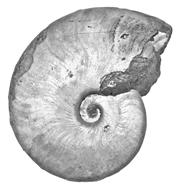
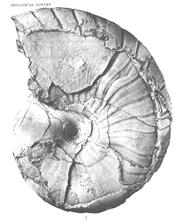
Subgenera. The subgenus Beudanticeras sensu stricto is moderately involute, with a stepped umbilicus and a generally slender whorl section. It is found throughout the Albian, in Europe, Egypt, Australia, Japan, Alaska, British Columbia, Texas, Argentina, and Greenland. The top photograph shows a Beudanticeras (Beudanticeras) revoili (Pervinquière, 1907) of 63 mm in diameter, from the Lower Albian of Madagascar. The polar subgenus Grantziceras Imlay, 1961, has a thicker, elliptical whorl section, a deep, funnel-shaped umbilicus, and a striated test with frequent falcate to biconcave constrictions. It is found in the Lower Albian of France, Alaska, and Svalbard. The lower photograph illustrates the holotype of Beudanticeras (Grantziceras) multiconstrictum Imlay, 1961, measuring 87 mm, from the Talkeetna Mountains in southern Alaska. It has whorls that increase rapidly in height and numerous closely spaced biconcave constrictions, hence its name.
Remarks. The subgenus Beudanticeras is problematic. It is found from the early Albian up to the benettianus zone (end of Lower Albian and base of Middle Albian), then it disappears (at least in the Anglo-Paris Basin) and reappears in the Upper Albian. Moreover, many diagnoses rely on pyritic nuclei but the the test can differ (constrictions on internal mold may be filled by ribs on the shell) and vary with age. Furthermore, some species have different sutures, some with relatively simple indentations, as in B. (B.) laevigatum Spath, 1827, while others have deeply divided sutures, as in B. beudanti. A few secies have abnormally strong ornamentation for the subgenus, such as B. komihevitraense Collignon, 1950 (see its entry). Finally, the adult stage is unknown in many species and sexual dimorphism is very little studied.
According to Latil et al. (2023), Beudanticeras and Grantziceras are two separate genera. They reserve the former for discoid forms from the Upper Albian, such as B. beudanti, showing a narrow umbilicus with an angular edge, weak falcate striae or ribs without constrictions, and a deeply incised suture, with a bifid and highly asymmetrical first lateral lobe (L1). The other forms, from the Lower Albian and the base of Middle Albian, have a symmetrical or slightly asymmetrical trifid L1 and constrictions at some stage of ontogeny. These are placed in a new genus, Roberticeras. Before following this revision, we await a wide acceptance from other authors.