Created 2023/04/16
Updated 2025/02/09
Beudanticeras (Beudanticeras) revoili (Pervinquière, 1907)
| Measurements |
D mm | H/D | T/D | O/D | H/T |
|---|
| Jaffré 2022 p.91 | 30 | 0.50 | 0.28 | 0.15 | 1.79 |
| Pervinquière 1907 | 37 | 0.52 | 0.27 | 0.21 | 1.90 |
| CP-12 | 63 | 0.51 | 0.30 | 0.16 | 1.68 |
| CP-48 | 104 | 0.49 | 0.29 | 0.17 | 1.70 |
| Collignon 1950 | 196 | 0.46 | 0.27 | 0.23 | 1.82 |
| Age |
Origin |
|---|
A. besairiei
Malagasy zone
Lower Albian
|
Ambatolafia
Boeny Region
Madagascar
|
Description.
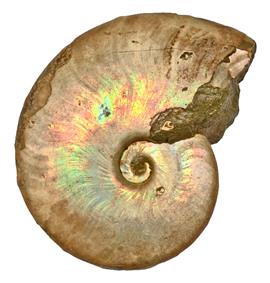
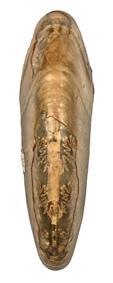
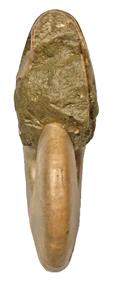
Flat ammonite with high whorls, 75% covered, and a nearly complete nacreous test. Small umbilicus with a straight wall sloping at 80°. On the inner third, the flanks are flat, barely diverging, then they become slightly convex and converge towards a narrowly arched venter. Hence a peri-umbilical flattening, visible in reflected light, noted by Pervinquière (1907) and Collignon (1950). Up to 45° from aperture, the internal mold is smooth, and the test shows only falcate growth lines, starting very proversely. Beyond this point, the mold shows three weak constrictions with the same course as the growth lines, appearing at the edge of peri-umbilical flattening, crossing venter with a proverse sinus, and followed by a thin ridge. The test fills the constrictions but amplifies the ridges into fine ribs.
Remarks.
A species from North Africa, Transcaspia, and Madagascar, but Jaffré (2022) presents a 30 mm sample that crossed the Burgundy threshold to get lost in Aube. Pervinquière depicts small and smooth pyritic specimens. Latil (2011) also shows such samples, plus a 140 mm calcareous mold. The constrictions on his specimens do not extend as far down the flanks. Specimens with a test, like ours and Collignon's, have about ten fine ribs per whorl. Corresponding to constrictions on the internal mold, they are visible from 5-6 cm in diameter and disappear at large diameters.
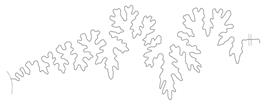
The species is closely related to B. (B.) newtoni Casey, 1961, restricted to Europe and Transcaspia, which is also smooth up to about 5 cm in diameter. However, the latter has slightly more convex flanks, a bit higher section, a little more open umbilicus, and stronger, falcate, and very proverse constrictions. To separate the two ammonites, B. (B.) revoili has a suture (above) in which the first lateral lobe has a narrower trunk.