| Measurements | D mm | H/D | E/D | O/D | H/E |
|---|---|---|---|---|---|
| EMP 1481* | 106 | 0.46 | 0.23 | 0.22 | 1.98 |
| CP-139 | 142 | 0.43 | 0.23 | 0.27 | 1.85 |
| Age | Origin |
|---|---|
|
Lower Albian Malagasy zone of Lemuroceras spathi & Brancoceras besairiei |
Ampanihy Boeny Region Madagascar |
| Measurements | D mm | H/D | E/D | O/D | H/E |
|---|---|---|---|---|---|
| EMP 1481* | 106 | 0.46 | 0.23 | 0.22 | 1.98 |
| CP-139 | 142 | 0.43 | 0.23 | 0.27 | 1.85 |
| Age | Origin |
|---|---|
|
Lower Albian Malagasy zone of Lemuroceras spathi & Brancoceras besairiei |
Ampanihy Boeny Region Madagascar |
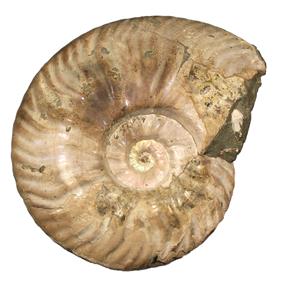
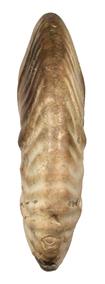
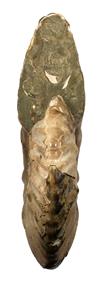
Description. A beautiful, flat ammonite with a pearly test, very high whorls with a 60% overlap, and on the last half-whorl a body chamber that no longer increases in height. The umbilicus is wide with a low, straight wall, sloping at 70°. The flanks are slightly convex up to their maximum thickness, reached in the inner quarter of the flanks, then flat and convergent towards an arched and pinched venter. Eight long ribs originate at the umbilical margin and follow a weak constriction. They are composed of three straight segments with rounded junctions: the first is proverse, the second radial, and the last projecting forward near venter. Between two long ribs, three to five intercalary ribs gradually arise. They become as strong as the long ribs on the outer third of the flanks. Some ribs bifurcate near venter. In total, 50 ribs cross the venter, slightly attenuated and forming a proverse sinus.
Remarques. Resembles two rare Malagasy Beudanticeras: B. (B.) ampanihense Collignon, 1963, and B. (B.) komihevitraense Collignon, 1950. The first, without a precise diagnosis, is maybe a variant with stronger ribs of the second. The latter has been found in Tunisia (Latil, 2011) and South Africa (Kennedy & Klinger, 2012); see also the enormous 26.5 cm specimen on www.ammonites.org. Our identification was confirmed by W.J. Kennedy. B. (B.) komihevitraense has an umbilicus that widens with growth. It has the same shape as Aioloceras besairiei, but the latter's ribs are blunt at this diameter, originating at some distance from the umbilical margin and fading on venter (see its entry). Riccardi and Medina (2002) believe that B. (B.) komihevitraense belongs to another genus (which they do not name), because it has ribs that are too strong compared to European Beudanticeras. However, Kennedy & Klinger (2012) provisionally maintain it in the genus and subgenus Beudanticeras.