Created 2023/05/03
Updated 2024/06/20
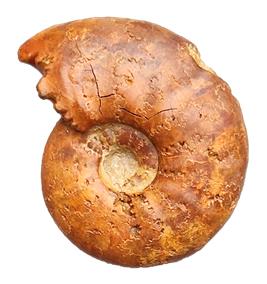
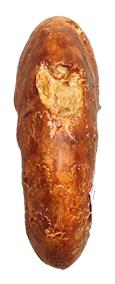
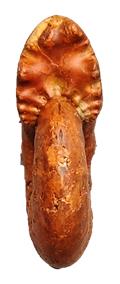
Beudanticeras (Beudanticeras) laevigatum (J. de C. Sowerby, 1827) – Microconch
| Measurements |
D mm | H/D | T/D | O/D | H/T |
|---|
| CP-93 | 30.5 | 0.43 | 0.33 | 0.25 | 1.27 |
| Jaffré 2022 p.87 | 33.4 | 0.45 | 0.30 | 0.23 | 1.50 |
| CP-653 | 35.9 | 0.47 | 0.31 | 0.23 | 1.54 |
| Age |
Origin |
|---|
Grey clay
H. benettianus zone, L. lyelli subzone
Middle Albian
|
Brévonnes
Aube
France
|
Description.
Preferably, read the macroconch entry first. Pyritic internal mold of a phragmocone, with well-exposed sutures. The whorls are quite compressed and overlap by 50%. The whorl section is ovoid, with well-convex flanks converging towards an arched venter and a maximum thickness at the inner third. Small umbilicus with an 80° wall passing to the flank via a rounded edge. Five ribs and one constriction cross the venter, but these are rather slight undulations in the direction of the spiral, visible only in tangent light. The suture is that of the macroconch (see its entry), with rectangular and slightly incised auxiliary elements forming a crenellated alignment.
Remarks.
Personal discovery. We follow Jaffré (2022) who interprets these small, rather thick forms as the microconchs of Beudanticeras (Beudanticeras) laevigatum. According to published specimens, the microconch does not exceed 55 mm, while the macroconch can reach 20 cm (see its entry). We have young macroconchs measuring 5 cm from the Frécambault Sands (Yonne). They are already clearly different from the microconchs, with a higher whorl section and flat, smooth sides.