Created 2023/09/16
2025/10/24
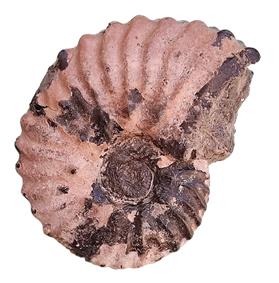
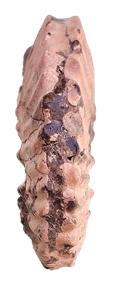
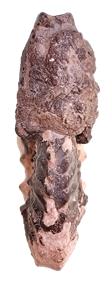
Epihoplites (Metaclavites) compressus (Parona & Bonarelli, 1897)
| Measurements |
D mm | H/D | T/D | O/D | H/T |
|---|
| LFS 167 Spath 1926 |
50 | 0.50 | 0.34 | 0.25 | 1.47 |
| Spath 1926 pl.16 fig.9 |
57 | 0.46 | 0.31 | 0.27 | 1.48 |
| CP-684 |
63.2 | 0.47 | 0.31 | 0.23 | 1.51 |
| CP-106 |
68.5 | 0.43 | 0.29 | 0.30 | 1.47 |
| CP-710 figured |
77.1 | 0.44 | 0.32 | 0.26 | 1.37 |
| Age |
Origin |
|---|
Phosphatic level P5
cristatum zone
Base of Upper Albian
|
Wissant
Pas-de-Calais
France
|
Description.
A fully septate, involute ammonite in black phosphate, with remnants of a pinkish test. Whorls 60% covered, with a high, compressed trapezoidal section, a narrow venter with angular shoulders, and nearly flat flanks becoming more convergent in the outer quarter. Umbilicus with a low wall sloping at 60° and a rounded margin. Eleven prominent umbilical tubercles, each gives rise to two non-lautiform ribs, with a shorter intercalary rib between two successive pairs. These ribs are initially curved forward. They then gradually become sigmoid, folded forward at the top of the flanks, with a steeper posterior slope than anterior. There are a total of 32 ribs, terminating in ventrolateral clavi without extending onto the venter. These clavi are nearly parallel to the siphon at the end of the spire and alternate on each side. The venter looks slightly concave due to the clavi. In fact, if you cross it between two coasts, it is flat, apart from vague zigzag connections between the clavi of the two sides.
Remarks.
Identification by Francis Amédro. CP-684 comes from level P5 at Wissant (cristatum zone), and it is the only ammonite with such characteristics in this level. It is found up to level P6 included (pricei zone), cf. Amédro (2009) and Amédro & Matrion (2022). D'Orbigny (1841) illustrates regular bundles of three ribs. In reality, a rib often detaches from its umbilical bulla: the good criterion is to have about three times more ribs or clavi than bullae. Asymmetrical rib slopes and folds at the top of the flank are frequent, as on CP-684 and plate 16 fig. 9 of Spath, but not systematic. E. (M.) metamorphicus Spath, 1925, is a more compressed variant with H/T ≥ 1.60. E. (M.) trifidus Spath, 1923, is on the contrary a thicker variant with H/T ≤ 1.00 (see its sheet).