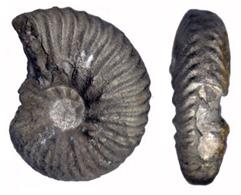
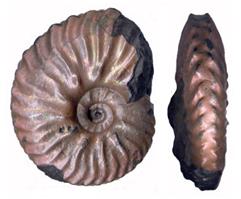
Description. According to Spath (1925) and Wright (1996), these ammonites are more or less involute, compressed to moderately inflated, with strong, rounded, but not lautiform ribs, arising from 2 or 3 from prominent umbilical tubercles. The venter is flat or slightly concave. Upper Albian of Europe and Transcaspia.
Subgenera. Casey (1965, p. 461) created the genus Metaclavites for forms with ventrolateral tubercles shaped like clavi parallel to the siphon, type Hoplites denarius var. compressus Parona & Bonarelli, 1897. This genus occupies the cristatum zone and the lower half of the pricei zone (beds VIII-IX at Folkestone, level P5 at Wissant). The genus Epihoplites, type Ammonites denarius J. de C. Sowerby, 1826, is restricted to species having rounded rib terminations (without clavi), more or less perpendicular to the siphon. It appears shortly after the Metaclavites and occupies the upper half of the pricei zone (bed X at Folkestone, level P6 at Wissant). Here we follow Wright (1996), who reclassifies Metaclavites as a subgenus of Epihoplites.
Main species. Amédro (1992) considers the species in each subgenus as variants of a primary species having anteriority. Thus, Epihoplites (Epihoplites) deluci (Brongniart, 1822) represents the following series, from most compressed to thickest: E. (E.) gracilis Spath, 1926, E. (E.) glyptus Spath, 1926 (top photographs), E. (E.) denarius J. de C. Sowerby, 1826, E. (E.) deluci and E. (E.) gibbosus, Spath, 1926. We do not provide the H/T ratios measured by Spath on his specimens because their intervals overlap, indicating poor separation. Epihoplites (Metaclavites) compressus defines the series: E. (M.) metamorphicus Spath, 1926 (H/T = 1.60-1.78), E. (M.) compressus (Parona & Bonarelli, 1897 (H/T = 1.47-1.53, bottom photos) and E. (M.) trifidus Spath, 1923 (H/T = 0.91-1.17). These H/T ratios are those of the Spath specimens. The photos come from Jim Craig's site.
Remarks. The two subgenera are similar in profile and both include compressed to thick forms. Only the ventral rib terminations allow them to be distinguished. According to Casey (1965, p. 461) and Saveliev (1992), Epihoplites (Epihoplites) gracilis is actually a Semenoviceras, because its suture line with low and broad elements is typical of the latter genus.