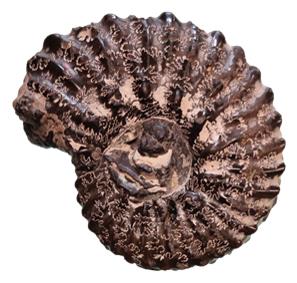
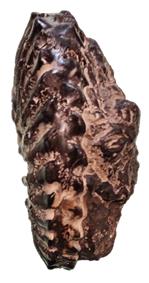
Epihoplites (Metaclavites) compressus – Other specimen
| Measurements |
D mm | H/D | T/D | O/D | H/T |
|---|
| LFS 167 Spath 1926 |
50 | 0.50 | 0.34 | 0.25 | 1.47 |
| Spath 1926 pl.16 fig.9 |
57 | 0.46 | 0.31 | 0.27 | 1.48 |
| CP-684 |
63.2 | 0.47 | 0.31 | 0.23 | 1.51 |
| CP-106 |
68.5 | 0.43 | 0.29 | 0.30 | 1.47 |
| CP-710 |
77.1 | 0.44 | 0.32 | 0.26 | 1.37 |
| Age |
Origin |
|---|
Phosphatic level P5
cristatum zone
Base of Upper Albian
|
Wissant
Pas-de-Calais
France
|
Description.
A beautiful, fully septate specimen from level P5 at Wissant, with the aperture and the unfigured face still embedded in its black phosphate nodule. The whorls are two-thirds covered, with a tall, compressed trapezoidal section, a narrow venter, and nearly flat flanks that become more convergent in the outer third. The umbilicus has a low wall sloping at 60° and a rounded edge. Thirteen prominent umbilical bullae each give rise to two ribs, with a shorter intercalary rib between successive pairs. These ribs, not lautiform, are proverse, well-rounded, slightly sigmoid, and barely curved forward at the top of the flanks.
There are a total of 34 ribs, terminating in low ventrolateral clavi, parallel to the siphon and alternating on either side of it. The venter is slightly concave and shows faint zigzag connections between the clavi of the two flanks. These zigzags are formed by the intercostal spaces that cut into the venter. Sutures beautifully exposed, with ventral lobe not centered on the siphon.
Remarks.
Identification by Francis Amédro. CP-684 and CP-710 both have flanks that are suddenly more convergent at the top of flanks, prominent umbilical tubercles, pairs of ribs ending in clavi parallel to the siphonal line, and sutures with the ventral lobe offset from the siphon. Curiously, Spath mentions this kind of offset in some late Anahoplites, but not in Epihoplites. However, the species is quite variable, since CP-710 is a little thicker than CP-684 and does not show ribs that are distinctly folded forward at the top of the flank, except around 2 o'clock on the profile view. Furthermore, the difference in slope between the two sides of the ribs is less pronounced and noticeable only on the last quarter of whorl.