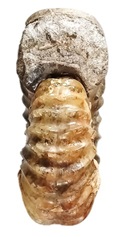
Forms. A first group includes three robust forms: T. subquadratus (see photo), orientalis, and suborientalis. Their umbilical and ventrolateral shoulders are narrow, the venter distinctly flattened, sometimes slightly convex or concave, and the umbilical wall rather low. Saveliev (1992) distinguishes a second group with T. finitimus and rossicus, compressed forms similar to Pseudosonneratia but with persistent umbilical bullae. Compared to the first group, they have a less flattened venter, more rounded shoulders, a lower umbilical wall, and flexuous ribs that are shorter but more numerous. A third group is restricted to T. dragunovi, a small involute species with a high rectangular cross-section and ribs crossing the venter in a straight line in the adult.
Distribution. Like the late Sonneratia with a hexagonal whorl section, the Tetrahoplites are confined to the puzosianus zone of Lower Albian. Fairly common in Transcaspia, the genus appears to be very rare in Western Europe. In the literature, only Casey (1965) includes a T. cf. subquadratus and a T. dragunovi, both found in Kent. The MNHN type database lists another T. cf. subquadratus (no. A25643) from Andon in the Alpes-Maritimes.
Remarks. The position of second group is unclear. Casey (1952) considered T. rossicus to be a Pseudosonneratia, without mentioning T. finitimus, still unknown at the time. However, Saveliev (1992) assigned both species to Tetrahoplites, based on their persistent umbilical bullae and the inconstant filiform groove on the siphonal line. To complicate matters further, Destombes in Rat et al. (1979) reported observing the same groove on some specimens of Pseudosonneratia from the Aube region (P. flexuosa, jacobi, and crassa).