Created 2023/03/05
Updated 2023/07/08
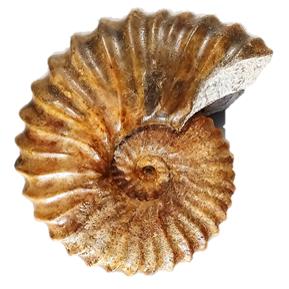
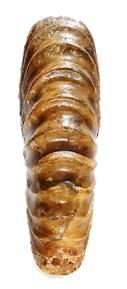
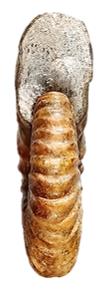
Tetrahoplites rossicus (Sinzow, 1907)
| Measurements |
D mm | H/D | T/D | O/D | H/T |
|---|
| CP-371 |
68.4 | 0.38 | 0.34 | 0.30 | 1.12 |
| CP-369 |
69.7 | 0.42 | 0.33 | 0.29 | 1.28 |
| Sinzow holotype |
72 | 0.38 | 0.34 | 0.30 | 1.10 |
| CP-364/17 |
86 | 0.41 | 0.29 | 0.28 | 1.43 |
| Age |
Origin |
|---|
O. sinzowi zone, P. (H.) puzosianus
subzone of the Mangystau
Lower Albian
|
North-Aktau Ridge
Mangystau Peninsula
Kazakhstan
|
Description.
Beautiful flattened ammonite with 50% overlapping whorls and the body chamber on the last half-whorl. The section forms a rectangle topped by a semi-circle: the venter is barely flattened; the flat sides, slightly converging, become parallel at the end of the spiral. The umbilical wall is low, straight, at 45° and rounds at the top towards the flank. 17 tubercles arise in the middle of this wall, they are inclined forward and straighten up shortly after the edge of the umbilicus to give pairs of ribs projected forward very high on the sides, hence an integral shape. The sharp ribs have a significantly steeper rear slope than the front and are gradually spaced out. They reach their maximum height on the venter, which they pass through with a broad, well-rounded sinus. Even the few intermediate ribs which arise higher on the flanks then follow the same path, which gives a very regular ornamentation of 33 ribs on venter.
Remarks.
Species only known in Mangystau. The section is more or less compressed and the ribs may be arched, but the very regular ribs are typical. In shape, the species resembles Tetrahoplites finitimus but it has a more open umbilicus, with a lower and less steep wall, and higher and more regular ribs. Breistroffer (1947) and Casey (1965, p. 539) place it in Pseudosonneratia given its section. Saveliev (1956) places it in Tetrahoplites because the venter flattens around 10 cm, the ribs have persistent umbilical bubbles and an asymmetrical section, the ventral sinus is less strong, and there is often a filiform furrow on the siphonal line, typical of the genus according to him. The generic position ofT. rossicus is therefore not clear, see the files for the two genera.