Created 2023/03/04
Updated 2026/01/22
Tetrahoplites suborientalis Saveliev, 1973
| Measurements |
D mm | H/D | T/D | O/D | H/T |
|---|
| CP-376/62 |
39.9 | 0.46 | 0.36 | 0.24 | 1.22 |
| 291/63 Saveliev holotype |
64 | 0.42 | 0.32 | 0.26 | 1.28 |
| CP-386 |
64.7 | 0.42 | 0.36 | 0.25 | 1.17 |
| Age |
Origin |
|---|
O. sinzowi zone, P. (H.) puzosianus
subzone of the Mangystau
Lower Albian
|
North-Aktau Ridge
Mangystau Peninsula
Kazakhstan
|
Description.
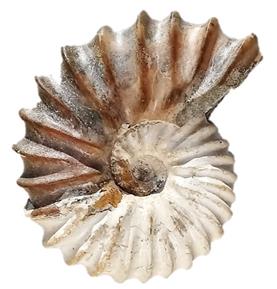
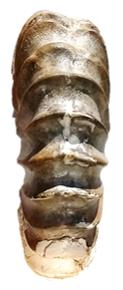
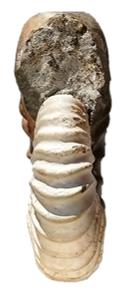
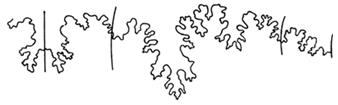
Compressed ammonite whose whorls overlap by 45% and slowly increase in thickness. The compressed section is trapezoidal. The body chamber is on 170° (gray in the profile view). The umbilical wall is abrupt at first then reduces to 45° at the aperture. 13 umbilical bullae, proverse on this wall, give pairs of ribs with straight crests on the flanks, steeper behind, crossinf venter with a shallow, rounded sinus. At the beginning of last whorl, the ribs are prominent and arched, the venter flattened a bit. Then they rise and become more spaced, sharp and almost straight on the flanks. There are 26 ribs, including 7 shorter simple ribs. The filiform ventral furrow, common in the genus, appears just before the body chamber and deviates from the siphonal line (malformation?). This specimen complies well with Saveliev's description. We give on the right the suture of holotype at 49 mm.
Remarks.
This species is only recorded in Mangystau. Saveliev created it in 1973 for the "Sonneratia jachromensis" in figures 12 and 18 of Sinzow (1907). We assign our specimen to this species based on the shape of its whorl section, but those in Sinzow are slightly more compressed and have more ribs (27-31). In fact, T. subquadratus (see its entry), orientalis (see its entry), and suborientalis form a series with increasingly compressed whorl sections, and our specimen falls between the latter two, indicating the existence of intermediate forms. Hence, all three forms may belong to the same species.