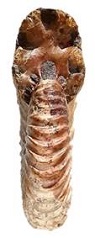
Possible confusions. Tetrahoplites also has a rectangular whorl section but umbilical bullae persisting with age and a weaker ventral sinus. While T. subquadratus and orientalis are easily identifiable by their square section, the compressed forms can resemble Pseudosonneratia. For example, Casey (1965, p. 539) classifies Sonneratia rossica Sinzow, 1907, as Pseudosonneratia, whereas Saveliev (1992) assigns it to Tetrahoplites. Destombes in Rat et al. (1979, p. 86) confirms that some specimens are difficult to identify because they are intermediate between the two genera. Like Pseudosonneratia, Hoplites (Isohoplites) steinmanni in its adult stage (see its entry) has forked ribs crossing a more or less flattened venter. However, its ribs are curved forward instead of being sigmoid. Furthermore, it appears later in the Lower Albian.
Cooper and Owen (2011) add that the ribs of Pseudosonneratia have a cross-section without notable asymmetry, unlike the ribs with a steeper rear slope in Isohoplites, Tetrahoplites, and the Sonneratia of the dutempleana group. Saveliev (1992) emphasizes the existence of a temporary filiform groove on the siphonal line of Tetrahoplites, but Destombes et al. (1974) and Destombes in Rat (1979) report the same detail in Pseudonneratia. However, none of the Pseudosonneratia illustrated by Destombes shows this famous groove, whereas it is visible on several Tetrahoplites from Saveliev and in our collection (see our entry for T. suborientalis). These contradictions need to be clarified.
Distribution. This genus is found in Europe and Transcaspia, but it is uncommon. In Western Europe, it appears in the floridum zone and reaches its peak in the puzosianus zone of the Lower Albian. For Mangystau, Saveliev (1992) only mentions the puzosianus zone.