Created 2023/02/04
Updated 2025/03/25
Pseudosonneratia kalugini Saveliev, 1992
| Measurements |
D mm | H/D | T/D | O/D | H/T |
|---|
| CP-394 |
34 | 0.46 | 0.35 | 0.24 | 1.29 |
| CP-385 |
65.3 | 0.42 | 0.32 | 0.26 | 1.29 |
| Holotype |
67.0 | 0.42 | 0.35 | 0.30 | 1.20 |
| Age |
Origin |
|---|
O. sinzowi zone, P. (H.) puzosianus
subzone of the Mangystau
Lower Albian
|
North-Aktau Ridge
Mangystau Peninsula
Kazakhstan
|
Description.
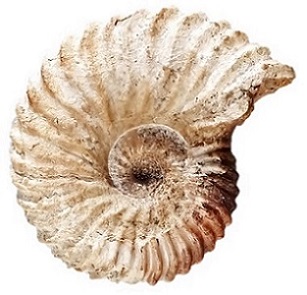
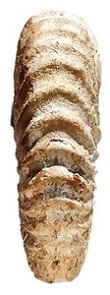
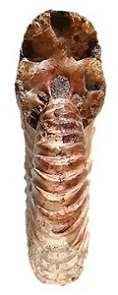
Nice phragmocone with a white test and whorls 50% covered. Compressed trapezoidal whorl section, with a flattened venter and well-defined ventrolateral shoulders. The shallow umbilicus, with a low wall at 35°, gradually transitions to the flank. The small umbilical bullae disappear at the beginning of last whorl. Then, the sigmoid ribs gradually emerge from the umbilical wall. They bifurcate at its edge and reach their maximum thickness on venter, where they form a proverse and rounded sinus of 120°. These ribs alternate with intercostal spaces of the same width, resulting in a very regular ornamentation. There are 38 ribs per whorl, only one of which is isolated. The Saveliev holotype is very similar, but with a more open umbilicus and slightly more ribs (43).
Remarks.
Species only known in Mangystau. The literature describes thirteen species of Pseudosonneratia: P. nolletiana (Lefort, 1894); P. rossica (Sinzow, 1907); P. iserensis and typica Spath, 1925; P. laffrayei Breistroffer, 1947; P. acuta, crassa, jacobi, occidentalis and praedentata Casey, 1965; P. flexuosa and paleodentata Destombes, 1979; and P. kalugini Saveliev, 1992. They range from compressed forms with numerous fine ribs (P. iserensis and P. praedentata) to thick forms with robust ornamentation (P. crassa). Saveliev (1992) writes that the species most closely related to P. kalugini is P. praedentata, but plate 90, fig. 1 of Casey shows pairs of arched rather than sigmoid ribs. His figure 203 shows a P. iserensis with similar ribs, but with slightly more convergent flanks and a more rounded venter.