| Measurements | D mm | H/D | T/D | O/D | H/T |
|---|---|---|---|---|---|
| CP-391 | 40.3 | 0.47 | 0.31 | 0.23 | 1.50 |
| Age | Origin |
|---|---|
|
O. sinzowi zone, P. (H.) puzosianus subzone of the Mangystau Lower Albian |
North-Aktau Ridge Mangystau Peninsula Kazakhstan |
| Measurements | D mm | H/D | T/D | O/D | H/T |
|---|---|---|---|---|---|
| CP-391 | 40.3 | 0.47 | 0.31 | 0.23 | 1.50 |
| Age | Origin |
|---|---|
|
O. sinzowi zone, P. (H.) puzosianus subzone of the Mangystau Lower Albian |
North-Aktau Ridge Mangystau Peninsula Kazakhstan |
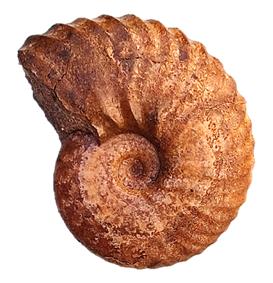
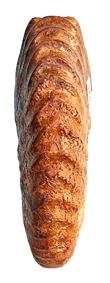
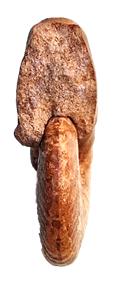
Description. Ammonite in fine-grained gray sandstone, covered with a brown test, with the body chamber on the last 70° and sutures visible in places. Whorls 40% covered, with a high trapezoidal section and slightly convex flanks and venter. Umbilical wall low and straight, at 70°, connected to the flank by a rounded edge. Ribs visible only in raking light on the first half of the last whorl, then clear. Primary ribs originate on the umbilical wall, rise slightly at the edge of umbilicus, but without widening, then divide into two proverse and sigmoid ribs that cross the venter where they reach their maximum height and form a strong rounded sinus. The primaries elongate near the aperture. Including some shorter intercalary ribs, there are 21 ribs on the last half-whorl.
Remarks. Spath (1925) created Pseudosonneratia for some of Jacob's Hoplites (Parahoplites) (1907, pp. 50-51), with two species: P. typica for the Parahoplites steinmanni of pl. 8, fig. 8, and P. iserensis for the Parahoplites cf. steinmanni of fig. 5. Although Jacob then Spath give neither a precise diagnosis nor measurements, CP-391 matches P. iserensis by its compressed form and its fine ribs. Casey copies Jacob's figure (1965, text-fig. 203, c-f) and created five other species, including a second one with fine ribs, P. acuta (text-fig. 206-d and pl. 90 figs. 7a-b). Defined on a quarter of whorl without measurements (H ≈ 20 mm according to the pictures), P. acuta nevertheless has a taller section (H/E ≈ 2) and, according to Casey, a sharp ventral chevron projecting far forward. P. iserensis resembles the compressed Sonneratia of the same ammonite zone, such as S. tenuis and titovi (see their entries) but is distinguished by its flattened venter, typical of the genus.