Description. Type Ammonites vespertinus Morton, 1834. According to Wright (1996), a more or less evolute genus with a square, rectangular, or trapezoidal costal section and a high or low siphonal keel. Ribs generally strong, which may taper or strengthen on the body chamber, with at least prominent internal umbilical and ventrolateral tubercles. At certain growth stages, one or two lateral tubercles and one external ventrolateral tubercle may appear. Upper Albian: Europe, Africa, India, North America, South America, Madagascar.
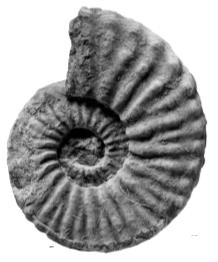
Subgenera in Wright (1996). Subgenus Mortoniceras (= Pervinquiera Böhm, 1910, and Subschloenbachia Spath, 1921). Type Ammonites inflatus J. Sowerby, 1817. Ribs rather fine to very strong, often bifurcated on young whorls, then simple, with umbilical and internal ventrolateral tubercles. Lateral tubercles may be present but weak. External ventrolateral tubercles noticeable at certain stages and in some species such as M. (M.) rostratum (J. Sowerby), and may be temporarily strong, foreshadowing subgenus Durnovarites. In some species all tubercles are weak. Rostrum erected, straight or coiled. Occurrence and distribution like the genus, but does not reach the top of the Upper Albian. The photo shows a M. (M.) fallax Breistroffer, 1940, 130 mm (from Worldham, Hampshire).
Subgenus Durnovarites Spath, 1932. Type Subschloenbachia perinflata Spath, 1922. Whorl section square to depressed trapezoidal. From the beginning at least four nearly equidistant tubercles on each rib, the outer one as prominent as the others, tending to become claviform. Europe, Africa, Madagascar.
Subgenus Deiradoceras Van Hoepen, 1931. Type Inflaticeras prerostratum Spath, 1921. Whorl section depressed to slightly compressed, subquadrate with a sharp keel. Costal section concave between the very strong umbilical and ventrolateral tubercles. Lateral tubercles may be present at some stages. Young whorls tending to have a rounded venter as in Dipoloceras. Rostrum tangent to the spire. Western Europe, Africa, Venezuela.
Other subgenera exist, but they are absent in Europe: Angolaites Spath, 1932; Boesites K. Young, 1968; Drakeoceras K. Young, 1957; and Pagoceras Van Hoepen, 1951.
Remarks. The increasing number of tubercles during Upper Albian provides a simple classification (Amédro, 1992). M. (M.) pricei has umbilical and ventrolateral tubercles. Next appear trituberculate species with lateral tubercles that diminish with age, such as M. (M.) inflatum (J. Sowerby, 1818). They are followed by trituberculate species with lateral tubercles persisting on body chamber: M. (M.) fallax (Breistroffer, 1940). The last forms have four tubercles (two ventrolateral): M. (Subschloenbachia) rostratum (J. Sowerby, 1817) and M. (Durnovarites) perinflatum (Spath, 1922). In the Amédro (1992) zonation for the Anglo-Paris Basin, the upper Albian comprises six zones, from the oldest: Dipoloceras cristatum, M. (M.) pricei, M. (M.) inflatum, M. (M.) fallax, M. (S.) rostratum and M. (D.) perinflatum.