| Measurements | D mm | H/D | T/D | O/D | H/T |
|---|---|---|---|---|---|
| Holotype | 80 | 0.39 | 0.39 | 0.34 | 1.00 |
| CP-3 | 198 | 0.29 | -- | 0.43 | -- |
| BM 88717 | 200 | 0.34 | 0.23 | 0.39 | 1.48 |
| Age | Origin |
|---|---|
|
Gault clay inflatum zone Upper Albian |
Saint-Jouin-Bruneval Seine-Maritime France |
| Measurements | D mm | H/D | T/D | O/D | H/T |
|---|---|---|---|---|---|
| Holotype | 80 | 0.39 | 0.39 | 0.34 | 1.00 |
| CP-3 | 198 | 0.29 | -- | 0.43 | -- |
| BM 88717 | 200 | 0.34 | 0.23 | 0.39 | 1.48 |
| Age | Origin |
|---|---|
|
Gault clay inflatum zone Upper Albian |
Saint-Jouin-Bruneval Seine-Maritime France |
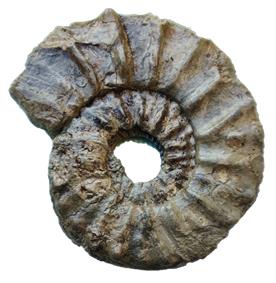
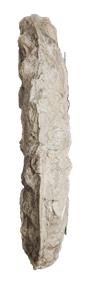
Description. Crushed large internal mold in grey clay. Only the last two whorls, 15% covered, are preserved. They include an indurated septate portion with visible sutures, and the body chamber on two thirds of last whorl. The section is compressed trapezoidal, with slightly convergent flanks, a flat venter, and a thin, pinched keel. The umbilicus is very wide with a low, subvertical wall and a rounded edge. 17 ribs arise abruptly from the umbilical margin. They are radial, straight, strong, but rounded. Most are simple, but some bifurcate at mid-flank, resulting in 22 ribs per whorl near venter. On the septate part, they bear a prominent umbilical bulla, elongated along the rib, a lower and shorter lateral bulla at mid-flank, and a ventrolateral tubercle consisting in a round and swollen rib termination. In the living chamber, the ribs become spaced apart and only the ventrolaleral tubercle remains: the lateral tubercle becomes indistinct, while the umbilical tubercle becomes rather a sudden onset of the rib.
Remarks. Personal discovery. Rather variable species reaching 50 cm in diameter. The section can be compressed to slightly depressed, with parallel or slightly convergent flanks. Compared to other Mortoniceras species, it has trituberculate ribs, the lateral one disappearing on the body chamber. The Albian layers of the Channel cliffs, between Le Havre and Saint-Jouin-Bruneval, comprise, from bottom to top, the Ferruginous Puddingstone, the Gault (dark grey clays from which our specimen originates), and the Gaize. The Gault is poor in ammonites: Breton (1998), Doré et al. (2006), and the explanatory note for the 1:50,000 geological map Montivilliers-Étretat mention only Prohysteroceras (Goodhallites) goodhalli, which has closer, sigmoid ribs, a keel on a fastigiate venter, and no lateral tubercles. I therefore report M. (M.) inflatum for the first time in these clays. The species is, however, quite common in the silicified beds of the Gaize, in the form of better-preserved specimens.