Created 2024/11/22
Updated 2025/07/28
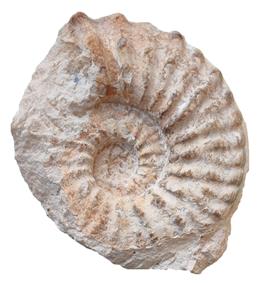
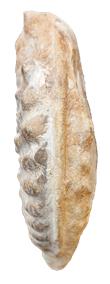
Mortoniceras (Mortoniceras) equidistans (Cragin, 1893)
| Measurements |
D mm | H/D | T/D | O/D | H/T |
|---|
| RJ-1729B |
105 | 0.35 | 0.32 | 0.36 | 1.10 |
| OUM KT 10536* |
139.5 | 0.32 | 0.27 | 0.43 | 1.18 |
| Holotype* |
169 | 0.24 | 0.27 | 0.42 | 1.25 |
* Specimens in Gale & Kennedy (2020)
| Age |
Origin |
|---|
Yellowish limestones
Mortoniceras equidistans zone
Duck Creek Formation
Upper Albian
|
Rock Creek
NW of Joshua
Johnson County
North Texas, USA
|
Description.
Internal mold in chalky limestone, entirely septate, with a 20% whorl overlap. Compressed rectangular costal section. Flat ventral surface with a siphonal keel of semicircular cross-section. Vertical umbilical wall connected to the flank by a rounded edge.
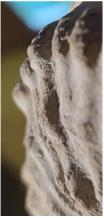
21 ribs with small spiral ridges originate on the umbilical wall and widen towards venter. They are trituberculate (photo on the right, in raking light), with an umbilical bulla visible very early, a lateral bulla appearing at mid-flank half a whorl from the end, and a large ventrolateral bulla. The outer bulla strengthens on the last quarter of whorl and forms a strong clavus, slightly projecting outwards and making a right angle with ventral surface. The three tubercles are equidistant, hence the name.
On the first half of last whorl, there is mainly an alternation of long and short ribs, with some bifurcated long ribs. On the last quarter of whorl, the ribs become simple and gradually more spaced. On the last half whorl, where the venter is intact, one can count 12 ribs originating at the umbilicus and 15 ribs on venter.
Remarks.
Outside of Texas, the species is known in New Mexico, England, and Nigeria. Cragin created it in 1893 but without photos. Cobban (1985) illustrated Cragin's Texas holotype, its section, and the suture lines. In 1987 he published pictures of specimens from the Sarten Sandstone Formation of New Mexico. Its synonymy includes Mortoniceras (M.) kiliani (Lasswitz, 1904). However, one of the M. (M.) kiliani in Spath (1932, pl. 38, fig. 1) is a M. (M.) fallax according to Gale & Kennedy, 2020. The latter resembles M. (M.) equidistans with its trituberculate ribs covered with fine clavi. But it is distinguished by lateral tubercles placed higher, at 2/3 of the height of the flank, and ribs that are wider at the umbilical edge.