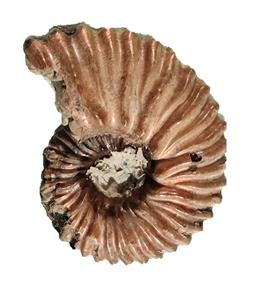
Description. Type species Acanthoceras milletianum (d’Orbigny) var. plesiotypicus, Fritel, 1906, p. 245, by original designation of Spath, 1923, p. 64. According to Wright (1996), more or less evolute genus reaching 40 cm in diameter, with a depressed whorl section in the young that may persist. The whorls subsequently adopt a compressed hexagonal or rectangular section, with a flat or slightly concave venter with angular shoulders. The primary ribs are straight or flexuous, tuberculate at the umbilical margin, and then bifurcate from a lateral tubercle. Secondary ribs are connected to primaries or intercalated. All ribs bear inconspicuous nodes on the ventrolateral angles. With growth, the tubercles disappear and the venter becomes rounded.
According to Casey (1965), the test is thickened on the crest of ribs: the ribs are therefore less prominent on the internal mold. We add that the ribs can bifurcate at the umbilical tubercle. The suture lines illustrated by Collet (1907) and Casey (1965) show a first lateral lobe with a trifid extremity, wider in its upper part and significantly deeper than the ventral lobe. Upper Aptian and Lower Albian, Europe, North Africa, Madagascar, Iran, California, Texas.
Remarks. The most messy genus with Acanthohoplites! Indeed, according to Kennedy et al. (2000), it gathers a large number of very similar species and varieties, many of which known as small nuclei. Casey (1965, p. 421–455) describes 9 classic species, creates 9 new plus 4 varieties, and cites 11 others! The statistical variability has not been analyzed. Moreover, the long synonymies in Mutterlose et al. (2003) show that many species have been mistaken for others over time. Finally, Latil & Jaillard (2023) point out that Hypacanthoplites even includes forms whose juveniles do not fit the genus diagnosis! A deep revision is therefore necessary.
A few species. In Aube, the Aptian ends with green sands and a glauconious sandstone bank which yielded the zone ammonite Hypacanthoplites milletioides (Casey, 1961). At the base of the Argiles Tégulines formation (grey clays), the Albian begins with a bed of sandstone-phosphate nodules containing H. milletianus (d’Orbigny, 1841, see his file). This layer condenses the Leymeriella (Leymeriella) tardefurcata (d'Orbigny, 1841) and Leymeriella (Neoleymeriella) regularis (d'Orbigny, 1841) zones. The genus is best known from small, pearly specimens (2-3 cm) found in clay quarries between Hanover and Braunschweig, Lower Saxony (Germany). The ammonites are embedded in small pebbles of black phosphate with a gray cortex. We follow Kennedy et al. (2000), who group several species into three forms, for which we present fact sheets: H. clavatus (Fritel, 1906), H. elegans (Fritel, 1906), and H. plesiotypicus (Fritel, 1906). The photograph shows the latter.
| Hypacanthoplites (4) | clavatus | elegans | milletianus | plesiotypicus |