Created 2024/04/17
Updated 2024/05/27
Hypacanthoplites clavatus (Fritel, 1906)
| Measurements |
D mm | H/D | T/D | O/D | H/T |
|---|
| CP-342 1 | 24.5 | 0.40 | 0.42 | 0.33 | 0.94 |
| Neotype H. clavatus 2 | 28.2 | 0.41 | 0.47 | 0.33 | 0.88 |
| Lectotype H. sarasini 2 | 37.9 | 0.47 | 0.39 | 0.27 | 1.13 |
| Néotype H. nodosicostatus 2 | 55.3 | 0.41 | 0.33 | 0.28 | 1.26 |
1 Measures including tubercles.
2 Specimens in Kennedy (2000)
| Age |
Origin |
|---|
Quarry of grey clay
schrammeni zone
Late Aptian-Basal Albian
|
Vöhrum
Lower-Saxony
Germany
|
Description.
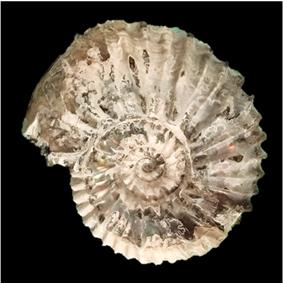
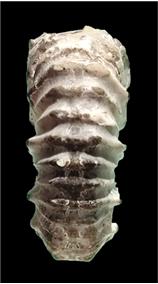
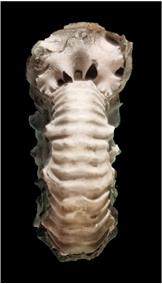
Small, septate specimen in black phosphate, with a partially preserved pearly test and sutures visible in places. Evolute coiling with whorls 20% covered. The section is somewhat depressed, resembling a rectangle with truncated upper corners. It appears distinctly depressed in the frontal view, because the venter is broken at the end of the spire.
The umbilicus, rather low and sloping at 60°, transitions to the flanks with a rounded edge. The prominent, slightly proverse but nearly straight ribs include primaries that arise at the umbilical suture, form a peri-umbilical bulla, and then bifurcate from a very prominent lateral bulla. This latter is barely visible on the profile view but quite distinct in the other two. The primaries are separated on average by two secondaries without lateral tubercles, appearing between the umbilical margin and mid-flank. These secondaries are shorter than the primaries on the flanks but almost as prominent on venter. In total, 35 ribs run straight across the narrow venter, forming bullae on the shoulders that make the venter slightly concave. The first lateral lobe is deep and narrows towards the bottom. Its end is trifid, with a very elongated central point.
Remarks.
This ammonite exhibits quite variable proportions, especially the H/T ratio (see table). However, it is distinguished from other small Hypacanthoplites from Vöhrum by its strong, prominent lateral tubercles, a narrower venter (due to the stronger ventrolateral truncations of the rectangular section), and distinct ventral tubercles instead of the usual small nodes.
Kennedy (2000) classifies H. nodosicostatus (Fritel, 1906) and H. sarasini (Collet, 1907) as this species. H. clavatus occurs at Vöhrum in the jacobi Zone (late Aptian) and in the schrammeni Zone (lower Albian), according to Mutterlose et al. (2003). But we do not know the exact collection level of our specimen, so it could be aptian or albian.