| Age | Origine |
|---|---|
|
Condensed phosphatic level kitchini to puzosianus zones Lower Albian |
Machéroménil Ardennes France |
| Age | Origine |
|---|---|
|
Condensed phosphatic level kitchini to puzosianus zones Lower Albian |
Machéroménil Ardennes France |
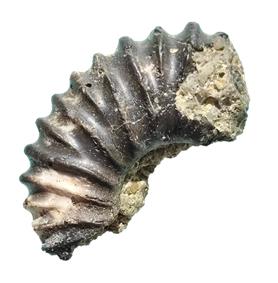
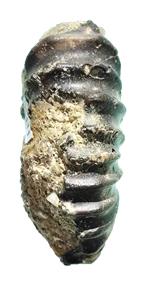
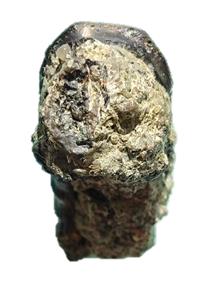
Description. A bit more than a quarter of whorl of a worn internal mold in black phosphate, with no visible sutures. The section resembles a rectangle with truncated upper corners. The umbilical wall, abrupt at its base, transitions to the flank with a rounded edge. The primary ribs are slightly bent backward on the umbilical wall, then fold forward and rise at the edge of the umbilicus. They are then straight, slightly proverse, and maintain the same height on two thirds of the flanks. They then rise gradually to reach their maximum height on ventral shoulders, but without widening. They cross the venter in a straight line and are lower on the siphon, because their crest is horizontal while the venter is convex between the ribs. They are separated by a secondary rib beginning at mid-flank, sometimes lower and very close to a primary rib. Two pairs of primaries without intercalaries are visible. All the ribs (10 on this quarter of whorl) are prominent, almost sharp, with slightly wider interspaces. They are all similar on the upper flanks and venter. There are no true umbilical or ventrolateral tubercles, only slight elevations. Lateral tubercles are absent.
Remarks. Personal discovery. D'Orbigny (1841, pl. 77, fig. 1-5) shows an idealized alternation of long and short ribs. Our CP-111 more resembles more the lectotype chosen by Casey (1965, text-fig. 160, f-g). The species is known in Aube in the bed of phosphatic, ferruginous sandstone nodules, which rest on the Aptian greensands. This level marks the beginning of Lower Albian (Leymeriella tardefurcata zone and Leymeriella regularis zone). It is also found in the condensed phosphatic level of Machéroménil (Ardennes) and in the main mammillatum bed of Folkestone, two levels which condense the kitchini, floridum and puzosianus zones. Its most recent zone is in fact unknown.