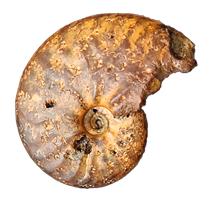
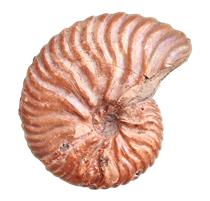
Description. Type species Ammonites cleon d'Orbigny, 1850. According to Casey (1966) and Wright (1996), these ammonites are discoid, compressed, and involute, with a narrowly rounded to sharp venter. The sigmoid or falcate ribs arise in groups of 1 to 4 from umbilical bullae and bifurcate at mid-flank, sometimes with shorter intercalaries. They are often attenuated on venter and tend to disappear with age. Lower Albian and early Middle Albian. Western Europe, Transcaspia, Madagascar, northwestern India, Alaska, and Canada (British Columbia). Two subgenera are found in Europe. Cleoniceras sensu stricto, type C. (C.) cleon (d'Orbigny, 1841), has umbilical bullae and its venter is never tabulated. Its age and geographic distribution are those of the genus. The rarer subgenus Neosaynella Casey, 1954 (type C. (N.) inornatum Casey, 1954) is very sparsely ornamented: it lacks umbilical bullae and its ribs are very weak, often reduced to crescent-shaped waves on the outer part of the flanks. It is restricted to the Lower Albian, in England, France, Transcaspiea, and Alaska. Destombes (1979) proposed a subgenus Cleonella for falciform ribbed forms such as C. (C.) floridum, but Owen (1988) considers it unnecessary.
A few species. In the subgenus Cleoniceras, C. cleon (d'Orbigny, 1841) is easily recognized by its very high whorl section (H/E ≤ 2) with a sharp venter and rather weak ribs (top image). Four related forms are thicker, with a wider venter and stronger ribs: C. devisense Spath, 1925 (bottom image); C. floridum Casey, 1961; C. janneli (Parent, 1893); C. quercifolium (d'Orbigny, 1841); and C. seunesi Bonarelli, 1921. In the subgenus Neosaynella, N. inornatum Casey, 1954, has a tabular venter in the young stage, then a sharp, and finally a rounded one. N. mangyschlakense Luppov, 1949, is a Transcaspia species with a narrowly rounded venter in the young, then a sharp one in adult and senile stages.
Remarks. C. (C.) floridum defines the ammonite zone between the kitchini and puzosianus zones in the Lower Albian. In the Aube region, the Cleoniceras range from this zone to the pseudolyelli subzone of the benettianus zone. Some "species" are very similar, and too few specimens have been collected, meaning their growth stages, variability and vertical extensions are unknown. Furthermore, sexual dimorphism is still poorly understood. This is why Matrion in Colleté (2010) believes a revision of the genus is necessary. Finally, it should be noted that most of the Malagasy "Cleoniceras" sold on the Internet have rather strong ribs, but no umbilical tubercles: these are in fact Aioloceras, see our fact sheets for this genus and three of its species.