Created 2023/08/17
Updated 2025/12/01
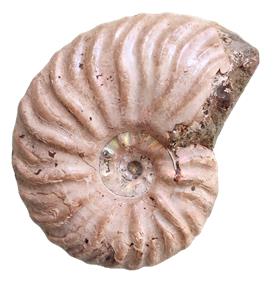
Cleoniceras madagascariense Collignon, 1949
| Measurements |
D mm | H/D | T/D | O/D | H/T |
|---|
| Collignon 1949 pl.17 fig.12 |
36 | 0.46 | 0.32 | 0.22 | 1.43 |
| CP-571 |
54.8 | 0.44 | 0.38 | 0.28 | 1.17 |
| CP-562 |
64.5 | 0.47 | 0.33 | 0.25 | 1.43 |
| Collignon 1963 fig.1181 |
72 | 0.46 | 0.36 | 0.29 | 1.27 |
| Age |
Origin |
|---|
A. besairiei
Malagasy zone
Lower Albian
|
Ambatolafia
Boeny Region
Madagascar
|
Description.
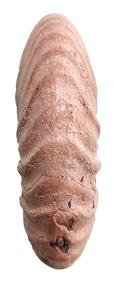
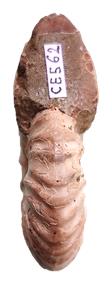
Nacreous involute phragmocone, with a subtriangular cross-section, a narrowly arched venter, and whorls two-thirds covered. Its maximum thickness is found at the inner third of whorl height. The umbilical wall is low, at 80°, and passes to the flank with a rounded edge. The umbilicus reveals the beginning of the ribs on the inner whorls, appearing as small, elongated, prominent bullae. On the last whorl, strong, falcate, rounded ribs arise abruptly from the umbilical edge. Their bullae are now only slight elevations, not spreading laterally. These ribs are strongly projected forward at the top of the flanks on the last half-whorl. Between two strong ribs, one or two weaker intercalary ribs arise progressively, more or less high on the flank. Some are very short. There are a total of 29 ribs, crossing the venter without attenuation, with a strong sinus proverse and irregular intercostal speces.
Remarks.
Species of variable thickness, see no. 571. Young whorls have an elliptical section, a 45° umbilical wall, and small, prominent umbilical bullae. With age, the section becomes higher and lanceolate, the umbilical slope increases, and the ribs emerge abruptly rather than forming true bullae. Kennedy & Fatmi took a better photograph of Collignon's type (2014, text-fig 13D-F).
This ammonite is often confused with the Aioloceras (see their entries). However, the latter have a higher and less triangular whorl section (H/E > 1.5), and less salient ribs, which emerge gradually near the umbilicus and are more or less effaced on venter.
On the Internet, small, pearlyC. madagascariense with an elliptical whorl section are often labeled Pseudosonneratia sakalava. However, this latter species is known only as non-pearly fragments (Collignon, 1965). Furthermore, it is unknown in the besairiei zone of Ambatolafia, from which almost all Malagasy Albian ammonites sold on the web originate.