Created 2023/08/15
Updated 2024/09/29
Cleoniceras (Cleoniceras) devisense Spath, 1925
| Measurements |
D mm | H/D | T/D | O/D | H/T |
|---|
| Paratype MPG 31351 | 20 | 0.55 | 0.30 | 0.20 | 1.83 |
| Holotype MPG 31350 | 31 | 0.53 | 0.30 | 0.19 | 1.77 |
| CP-439 | 49.3 | 0.49 | 0.31 | 0.17 | 1.60 |
| Age |
Origin |
|---|
Grey clay
H. (I.) steinmanni zone
Lower Albian
|
Pays de Bray
Seine Maritime
France
|
Description.
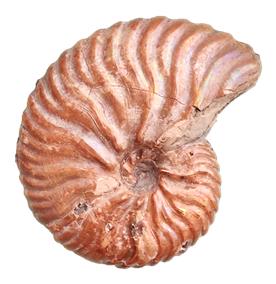
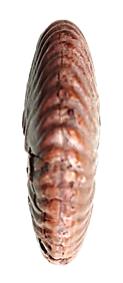
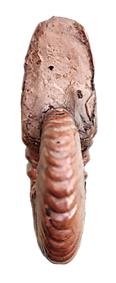
Beautiful pearly specimen with body chamber on last half-whorl. The whorls, 80% covered, have a compressed elliptical section, and a broadly rounded venter, slightly flattened at the end. Small, vertical umbilicus with a curved edge bearing 10 proverse bullae. Each one gives rise to a proverse and straight primary rib, lengthening progressively and branching into 2-4 concave secondary ribs. The latter separate at varying heights from the primaries or detach as intercalaries. In total, 42 similar, closely spaced ribs cross venter without attenuation and with a strong proverse sinus.
Remarks.
No, it doesn't come from Bully! This species is known in Aube from the subhilli zone to the pseudolyelli subzone of benettianus zone (Matrion, 2010; Amédro et al., 2014). See other specimens in Spath (1925, pp. 94–95 and pl. IV, fig. 7) and Matrion (2010, fig. 97D). Four other Cleoniceras differ from C. cleon by a thicker cross-section and stronger ribs. The last three could be synonyms according to Riccardi & Medina (2002).
C. floridum Casey, 1961, has ribs effaced at mid-flank, hence fuzzy connections to the bulla, and a theoretically smooth siphonal band (but absent on Jaffré's specimen, 2007).
C. quercifolium (d'Orbigny, 1841) has stronger ribs, a less compressed section (H/T = 1.32–1.45 for specimens in Casey, 1966), and a more open umbilicus. D'Orbigny's figure shows a flat, smooth ventral band, but it is amplified and not always present according to Casey.
C. seunesi Bonarelli, 1921, has parallel lower flanks and a sharp, angular venter.
C. janneli (Parent, 1893) most closely resembles C. devisense, but it has a more open umbilicus and a subrectangular cross-section; see a fine specimen in Matrion (2010, fig. 97C). Moreover, in Aube, it is only known in the puzosianus zone.