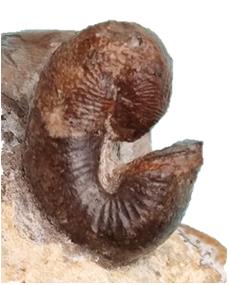
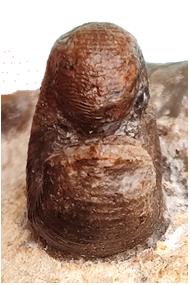
Scaphites hugardianus d'Orbigny, 1842
| Measurements |
D mm 1 | H/D | T/D | O/D 2 | H/T |
|---|
| Ce 1221/7 3 |
21 | ? | 0.62 | 0 | ? |
| CP-292 |
21.3 | 0.27 | 0.59 | 0 | 0.46 |
1 D = maximum distance between initial spiral and cross
2 O = umbilical diameter of initial spiral
3 Specimen from Tübingen university cited in Wiedmann (1965)
| Age |
Origin |
|---|
Base of Pénzeskút marls
Condensed Upper Albian
rostratum to perinflatum zones
|
Tilos forest
Village of Pénzesgyõr
Bakony Hills, Hungary
|
Description.
A small, heteromorph ammonite made of brown phosphate, part of an assemblage on a block of gray limestone. The spire has depressed whorls that completely overlap, thus lacking a visible umbilicus. The short shaft, with a kidney-shaped cross-section and a concave venter, widens rapidly. The cross folds abruptly upward and almost touches the initial spire; it also has a reniform section, but it is constricted near the mouth, which is bordered by a small collar.
Under magnification, the spire bears fine, equidistant, and very closely spaced ribs. These are convex on the flanks and cross the venter with a broad proverse sinus. Some are bifurcated. On the shaft and cross, the ribs are slightly stronger, less closely spaced, and gradually appear on the dorsal shoulder. Some bear a small lateral tubercle, where most bifurcate. These tuberculate ribs are separated by 2 to 4 ribs similar to those of the spiral. No visible sutures.
Remarks.
S. hugardianus is common in the Upper Albian of Salazac (Gard, France) and Pénzesgyõr (Hungary). Unlike ours, some specimens may have a slightly open umbilicus and/or an internal swelling at the beginning of the shaft. The species resembles S. simplex Jukes-Browne, 1975, and S. meriani Pictet & Campiche, 1861. Cooper (1990) believes the latter two to be variants of S. hugardianus, while Wright & Kennedy (1996) consider S. hugardianus to be a dubious taxon (nomen dubium), because d'Orbigny did not clearly designate a type and his description does not correspond to his illustrated specimen. Wiedmann (1965) and Jattiot et al. (2021) however maintain S. hugardianus because the use of this species name has been recognized for a long time.