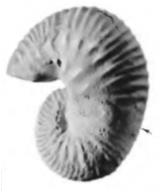
Description. Genotype Scaphites equalis J. Sowerby, 1813. Small, heteromorph ammonites (maximum length 4 cm), compressed to very inflated, with an initial spiral that is more or less involute, with whorls in contact, followed by a short to moderately elongated shaft, straight or slightly curved in the direction of coiling, then by a cross that does not reach the initial spiral, with, in the adult, a constricted aperture often bearing a collar and sometimes a long dorsal apophyse. The ribs on the initial spiral are normally long and short or bifurcated; those on the shaft are simple or bifurcate, generally from ventrolateral tubercles. Umbilical and ventrolateral tubercles may be present on the shaft and cross.
Suture with a bifid L initially, becoming asymmetrical in the Upper Turonian and then trifid thereafter. Main saddle (S) very wide and notched by at least one auxiliary lobe ("pseudolobes" of Wiedmann). The microconchs are not much smaller than the macroconchs, but the inner side (the dorsum) of their shaft is flat or concave, while that of the macroconchs is convex, which more or less closes the umbilicus; see photographs in Wright & Kennedy (Lower Chalk, vol. 5, 1996). Late Albian to Campanian. Northern Hemisphere, Argentina, Australia (Queensland), Madagascar, New Zealand.
A few species. Upper Albian species include Scaphites hugardianus d'Orbigny, 1842, S. simplex Jukes-Browne, 1975, and S. meriani Pictet & Campiche, 1861. Cooper (1990) considers the latter two to be variants of S. hugardianus, while Wright & Kennedy (1996) think the latter is a doubtful taxon, as it lacks a clearly designated type. Two species are common in the Cenomanian of the Anglo-Paris Basin: S. obliquus and S. aequalis, both from J. Sowerby, 1813. The Scaphites were widespread in the American Western Interior Seaway, such as S. hippocrepis DeKay, 1828, in the Campanian. Many larger Scaphites found in the Campanian and Maastrichtian stages of this region have been reassigned to closely related genera. For example, S. nodosus Owen, 1852, is now classified within the Hoploscaphites, characterized by a short shaft and strong ventrolateral tubercles shaped like spines or clavi.
Remarks. The genus Scaphites is probably polyphyletic given its very long duration. The photograph shows a Scaphites hippocrepis from the Campanian of Wyoming (Cobban, 1969). It is a macroconch, as the dorsum of the shaft is convex and partially obscures the umbilicus. The beginning of the body chamber is indicated by the arrow: it comprises most of the shaft and the cross.
| Scaphites (1) | hugardianus |