Created 2024/11/05
Updated 2024/11/28
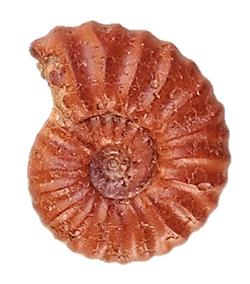
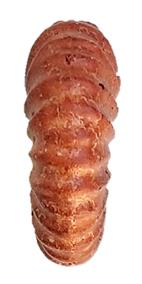
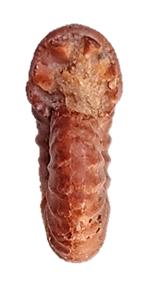
Pseudobrancoceras versicostatum (Michelin, 1838)
| Measurements |
D mm | H/D | E/D | O/D | H/E |
|---|
| CP-665 |
19.9 | 0.40 | 0.33 | 0.29 | 1.21 |
| CP-664 |
20.1 | 0.38 | 0.39 | 0.33 | 0.96 |
| EMP A246/3* |
23.5 | 0.40 | 0.38 | 0.31 | 1.07 |
| ID 2010/2* |
25.6 | 0.38 | 0.39 | 0.33 | 0.97 |
* Specimens in Kennedy (2004)
| Age |
Origin |
|---|
Grey clay, lyelli subzone
benettianus zone
Middle Albian
|
Brévonnes
Aube
France
|
Description.
A small, pyritic phragmocone with a nearly circular section and a broad venter without distinct shoulders. The whorls overlap by 30%. The umbilicus has a convex wall and a rounded edge. The maximum thickness is reached slightly above the edge of umbilicus. 19 primary ribs appear on the umbilical wall. They are radial and strengthen slightly at the top of the flanks, where some bifurcate, then cross the venter in a straight line. The ribbing is irregular on venter. Some ribs terminate at the ventrolateral shoulder of the opposite flank. Some ribs bifurcate and form a loop on the venter, reconnecting on the other side. A secondary rib is even observed connecting to another primary rib on the opposite flank. Because of these unusual features, which could be mistaken for malformations, there are a total of 30 ribs on the venter.
Simple suture, little incised, with bifid saddles and smaller, narrower lobes.
Remarks.
Personal discovery. Kennedy (2004) created the genus Pseudobrancoceras for some Brancoceras with irregular ventral rib connections. P. versicostatum has been found in the Aube, Yonne, and Alpes-Maritimes departments. It is slightly compressed to somewhat depressed. The largest known specimen is only 26 mm in diameter. Pseudobrancoceras transiens Kennedy, 2004, has identical ribs and sutures. It is distinguished by a consistently slightly compressed whorl section and the presence of small ventrolateral and siphonal tubercles, the latter being more numerous than the former.